Growth Starts by Staying Close to the Work

As businesses grow, leaders naturally become further removed from the work that originally taught them how the company actually operates. Customer conversations become reports. Frontline frustrations become metrics. Employees become headcount. The larger the organization becomes, the easier it is for leadership to understand the business primarily through numbers rather than through the people creating those numbers every day.
That distance can become dangerous because some of the most important information in any organization lives closest to the customer. It comes from the technician who hears what homeowners are saying, the employee who sees a process break down repeatedly, the manager trying to support a struggling team member, or the customer who is frustrated enough to pick up the phone and tell you exactly where the business failed.
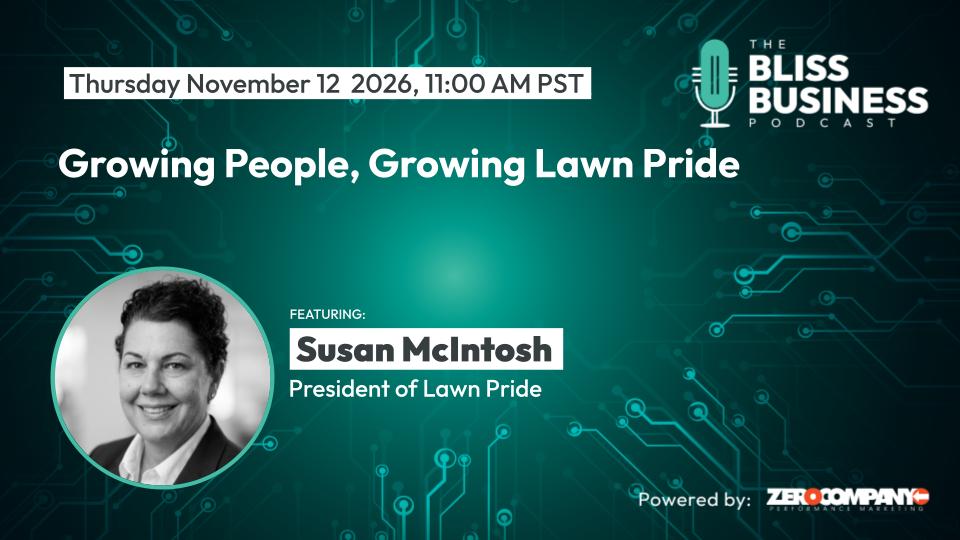
Susan McIntosh has spent more than three decades learning that lesson from virtually every level of Lawn Pride. Today she serves as President of the lawn care company, which is part of the Neighborly family of home service brands. But her career did not begin in an executive office. She started with hands-on responsibilities, customer service, and the everyday work of helping build the company from the ground up before moving into management, operations, and eventually executive leadership.
On The Bliss Business Podcast, Susan shared how that experience continues to shape the way she leads a business serving roughly 21,000 customers while supporting both a substantial corporate-owned operation and a growing franchise network.
Her philosophy is remarkably consistent: stay connected, listen carefully, take care of people, and never become too important to do the work that needs to be done.
Leadership Credibility Is Built Before You Get the Title
There is a particular kind of credibility that comes from having done the work yourself.
Susan knows what it feels like to handle customer problems because she has handled them. She understands the realities technicians face because she has worked alongside them. She knows the business from the ground level rather than only through reports presented in a leadership meeting.
That experience changes the relationship between leader and employee.
When someone knows that the person leading them has faced similar challenges, there is less distance between the role and the reality. Susan described a simple philosophy she has carried with her throughout her career: nothing is beneath her. If something needs to be done, including cleaning a bathroom, she is willing to do it.
That attitude communicates something far more important than humility alone. It tells people that everyone contributes to the mission and that leadership is not an exemption from responsibility.
Susan also learned that leadership becomes different once you become responsible for developing others. You cannot promote someone simply because you like them or because they have been around for a long time. Caring about someone means investing in their development, listening to them, understanding where they can succeed, and sometimes telling them where they still need to grow.
Trust becomes essential.
When people genuinely believe a leader has their back, Susan has found that they often respond with extraordinary loyalty and commitment. That became particularly visible when Lawn Pride was acquired by Neighborly in 2022. Organizational transitions can create uncertainty, especially when a longtime private business joins a much larger organization. Yet nearly the entire management team remained.
Susan made a conscious decision that while ownership might have changed, the feeling of being part of something together did not have to disappear.
Staying Connected Is a Leadership Discipline
As Susan’s responsibilities expanded, it would have been easy to retreat further from customers.
She did the opposite.
Until only a few years ago, she continued taking customer service calls herself, including the difficult ones. In fact, she particularly wanted to hear from customers who were angry enough to be considering leaving.
Those conversations became an invaluable source of intelligence.
A dissatisfied customer does not simply tell you that something went wrong. If you are willing to listen and ask additional questions, they can reveal what is happening inside the business. They can expose a service problem, a training issue, an operational weakness, or even an emerging lawn condition affecting multiple customers.
The information is richer because the conversation is interactive. A survey can tell you that someone is dissatisfied. A direct conversation allows you to understand why.
Susan also understands that mistakes are inevitable. Lawn Pride has customers who have remained with the company for decades even though the company made significant mistakes along the way. They stayed because the organization acknowledged what happened, took the problem seriously, and made it right.
That is a powerful customer experience lesson.
Loyalty does not always come from perfection. Sometimes loyalty becomes stronger when a customer experiences a mistake and then discovers how seriously the company takes responsibility for fixing it.
The same principle applies internally. Susan’s advice to leaders moving away from frontline responsibilities is simple: stay connected. Walk into the shop. Talk with technicians. Ask what customers are saying. Recognize someone when you hear they handled an interaction exceptionally well.
The higher leaders rise, the more intentional they must become about remaining connected to the reality everyone else is experiencing.
Customer Care Becomes Scalable When It Becomes Part of the Process
Lawn Pride grew substantially by becoming more focused.
Earlier in its history, the company performed a wide variety of landscaping services. Around 2011, leadership made a deliberate decision to concentrate more heavily on what it believed it did particularly well, including lawn applications such as fertilization and weed control.
That focus helped the business strengthen the service experience and expand from a few hundred core lawn application customers in its early days to roughly 21,000 customers today.
But growth creates another challenge: how do you preserve personal care when thousands of customer relationships are being managed by many different employees and franchise owners?
For Susan, the answer is to build human behaviors into the operating system.
One example could hardly be simpler. When a technician arrives at a customer’s home, the process begins by getting out of the vehicle, walking to the door, and greeting the customer.
That small act matters.
It tells the homeowner that someone has arrived. It creates an opportunity for communication. It reminds the technician that there is a person connected to the lawn being serviced.
Over time, technicians come to know the homeowners on their routes. They know the customer’s name. They may know the dog’s name. They develop familiarity and trust.
Susan’s longstanding belief is that if the company takes care of the customer, the customer will take care of the business.
That sounds simple, but simplicity does not make it easy. It has to be translated into repeatable behavior. Otherwise, care remains an aspiration rather than becoming part of how the business actually operates.
Systems Should Support People, Not Ignore Reality
Scaling a service business requires processes. Franchising makes them even more important because customers should receive a recognizable Lawn Pride experience regardless of market.
But Susan is equally clear that processes cannot be designed exclusively from an office.
She described the need to remind herself that she can make decisions while sitting in a comfortable environment, while the people affected by those decisions may be working outside in cold rain, heat, or other challenging conditions.
That perspective changes how leaders evaluate systems.
Something that looks efficient from headquarters may be frustrating in the field. A process that appears perfectly logical on paper may create unnecessary work for the person responsible for executing it.
The only way to know is to listen.
Lawn Pride uses channels such as its Franchise Advisory Council to surface issues franchise owners are seeing and to discuss the subjects people might otherwise avoid. Susan welcomes ideas from across the network and does not believe there is such a thing as a bad suggestion.
That does not mean every suggestion becomes policy.
Her responsibility is to consider whether an idea benefits the entire network rather than only one individual operator. Listening does not require automatic agreement. It requires making people feel that their experience matters enough to be considered seriously.
The same balance applies to customer requests.
Susan has learned that saying yes to every special request can actually create worse service. If a customer asks for a recurring exception that falls outside the company’s systems, Lawn Pride may be more likely to miss the expectation later.
Rather than promise something the operating model cannot reliably support, Susan teaches teams to explain the limitation honestly.
Sometimes saying no is an act of service because an honest expectation is better than a promise the organization cannot consistently keep.
Training Is How Culture Survives Growth
Consistency does not happen because people attended orientation once.
It requires repetition.
Lawn Pride uses regular team gatherings to discuss what went well, surface challenges technicians are experiencing, cover safety issues, and reinforce the practices required to deliver consistent service.
Susan’s view is that training never really ends. Even if something has already been taught, it will need to be taught again. New employees arrive. People forget. Conditions change. Skills improve through repetition.
That investment is particularly important when the goal is to create a consistent experience across employees, locations, and franchise owners.
But training alone does not create culture.
People also need opportunities to build relationships.
Susan appreciates Neighborly’s practice of incorporating “fun in the process” into gatherings. Franchise owners might come together for formal training, but they also spend time having dinner, participating in activities, and interacting outside the structured business environment.
Those experiences create a different kind of connection. Leaders learn what motivates people. Franchise owners get to know one another. People begin forming relationships they can rely on later when a difficult situation emerges.
When Susan joined the larger Neighborly organization after spending most of her career inside one company, she discovered another benefit of scale: access to people who have already encountered challenges similar to the ones she is facing.
Her advice to people joining that kind of organization is to “find your people.”
Those relationships become part of the infrastructure supporting leaders themselves.
Developing People Means Helping Them See More Than Their Job
Susan describes herself as a fixer and a helper.
One of the aspects of leadership she enjoys most is watching people become successful, particularly when they begin discovering capabilities they did not initially recognize in themselves.
Her approach is to give people visibility beyond their immediate responsibilities.
An employee may understand one piece of the operation very well, but when a leader helps them see how that piece connects to the larger business, something changes. They begin understanding why the work matters. They start seeing relationships between departments, customers, employees, and financial outcomes.
That broader perspective can unlock confidence.
Many people assume they are not capable of responsibilities they have never experienced. A good leader can help them stretch by providing context, encouragement, and opportunities to learn.
The same philosophy applies to new franchise owners.
People enter franchising from different backgrounds, and they may initially feel overwhelmed by the technical details of lawn care. Susan reminds them that those things can be taught. They do not need to arrive knowing everything. They need to be willing to learn, follow the systems, ask for help, and understand why something went wrong when they encounter setbacks.
Confidence grows through understanding.
When someone makes a mistake, Susan’s instinct is not simply to tell them what they did wrong. She wants them to understand why it happened so they can respond differently the next time.
That is the difference between correcting a mistake and developing a person.
Love in Business Means Showing Up for People
When Susan was asked what role love should play in business, her answer reflected the way she already leads.
Love means showing people that you care.
Sometimes an employee arrives at work carrying something difficult from outside the business. A leader cannot solve every personal problem, nor should care become an excuse for enabling poor behavior. But leaders can recognize that the person standing in front of them is a human being having a difficult day.
You can help someone get back up without eliminating accountability.
The same applies to franchise owners. They have invested money, time, energy, and often a significant part of their lives into building a business. Susan takes that responsibility personally. She wants them to know the franchisor is not simply handing them a system and wishing them luck.
The organization is there to help them succeed.
Her most practical recommendation for leaders who want to become more empathetic is an open-door policy that is genuinely open. People need to know they can come in, talk, and sometimes simply be heard.
The moment a leader closes the door figuratively or literally and disconnects from people, Susan believes they begin losing sight of what matters.
That idea may also explain how she thinks about legacy.
Her goal is not merely for Lawn Pride to continue growing. She wants the business to continue operating in a way that makes people love their jobs and want to be part of what the organization has built.
Of course, she also wants beautiful lawns.
But the larger legacy is the people.
Key Takeaways
-
Leaders who have experienced frontline work gain credibility and empathy that can strengthen how they lead others.
-
Staying connected to customers and employees becomes more important, not less, as leadership responsibilities grow.
-
Difficult customer conversations can become valuable feedback loops that expose problems before they become larger organizational issues.
-
Customer loyalty does not require perfection. Taking responsibility and making mistakes right can strengthen trust.
-
Care becomes scalable when human behaviors, such as greeting customers personally, are intentionally built into operating processes.
-
Processes should be tested against the reality of the people expected to use them, not only against how efficient they appear from headquarters.
-
Listening to ideas does not mean implementing every idea. Leaders still have a responsibility to determine what benefits the entire organization.
-
Sometimes saying no to an unusual customer request creates better service than promising something the system cannot reliably deliver.
-
Culture requires continual training, reinforcement, relationships, and opportunities for people to connect beyond their formal responsibilities.
-
Developing people means helping them see the larger picture and discover strengths they may not yet recognize in themselves.
-
Love in leadership combines care with accountability and requires leaders to remain accessible enough to understand what people are actually experiencing.
Final Thoughts
Susan McIntosh’s journey illustrates something leaders can easily forget as organizations become larger and more sophisticated: growth should not require becoming disconnected from the people who made the growth possible. The reports, systems, KPIs, and processes matter, but they are representations of something happening in the real world between employees and customers every day. Leaders who stop experiencing that reality eventually risk making decisions for a business they understand primarily through abstraction.
Staying close to the work does not mean a president should continue doing every frontline job. It means building deliberate ways to listen, remaining accessible, walking into the shop, asking questions, hearing from customers, and understanding how decisions made in comfortable offices affect people working in very different circumstances. That connection protects empathy as the organization scales.
It also changes the purpose of leadership. Instead of simply ensuring that people perform their roles, leadership becomes about helping people become capable of more. Training builds competence. Encouragement builds confidence. Trust creates ownership. Honest feedback helps people grow. Strong systems give them a reliable foundation from which to succeed.
Perhaps the simplest expression of Susan’s philosophy is also the most powerful: show up. Show up for customers when something goes wrong. Show up for employees when they need support. Show up for franchise owners who have invested their lives into the business. And keep showing up as the company grows, because the moment leaders become too distant to hear the people around them is often the moment they begin losing the very thing that made the organization successful in the first place.
Check out our full conversation with Susan McIntosh of Lawn Pride on The Bliss Business Podcast.

Executive Producer | Host | Blog Contributor
Tullio Siragusa is a strategic advisor, dynamic speaker, author, and EQ coach with 36 years of experience as a technology disruptor rooted in Design Thinking. Since 2018, he has been creating, producing and hosting live podcasts, interviewing over 1,000 C-suite executives across a wide range of industries. His work behind the mic reflects his larger mission: using conversation as a catalyst for human-centric innovation.
Tullio’s commitment to purpose-driven leadership and ethical transformation is reflected in his advisory roles at the University of California, Riverside’s Design Thinking Executive Program, and the University of San Francisco School of Management’s Digital Marketing Program. As a Board Advisor at AI2030.org, he helps guide the responsible advancement of AI toward ethical and sustainable outcomes. A founding member of RadicalPurpose.org, Tullio believes empathy isn’t just a trait, it’s a non-negotiable foundation for leadership.

The Stories That Matter Start With People