Empathy Should Never Be Outsourced

Businesses have never had more information about the people they serve.
We can track behavior, analyze preferences, anticipate needs, personalize messages, and increasingly use artificial intelligence to predict what someone might do next. Marketing teams can know where customers spend time, what they care about, what stage of life they are entering, and what message may be most likely to influence a decision.
But having more data about people is not necessarily the same as understanding them.
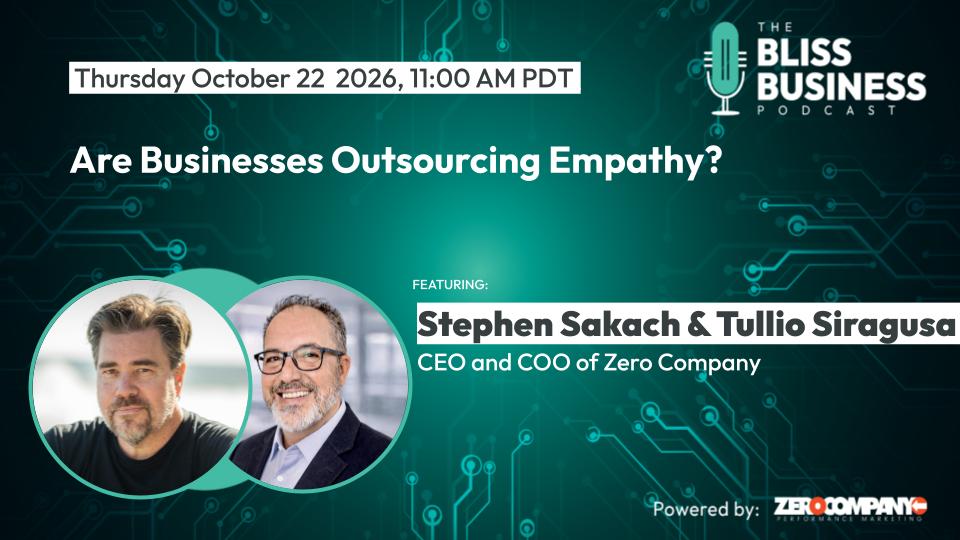
That distinction became the center of a recent conversation between Stephen Sakach and Tullio Siragusa on The Bliss Business Podcast. Stephen had come across an article using the phrase “outsourcing empathy,” and it immediately raised a larger question for both of us: as companies replace more human interactions with automation, algorithms, self-service, and AI, are we becoming better at understanding people, or simply better at influencing their behavior?
The answer matters because artificial intelligence may become one of the most powerful tools for persuasion ever created. It may also become one of the most powerful tools available to help businesses understand different perspectives, anticipate human needs, and design more empathetic experiences.
The technology itself will not decide which direction we take.
Businesses will.
Empathy Is Not a Non-Core Business Function
When I first heard the phrase “outsourcing empathy,” my reaction was almost disbelief.
Businesses typically outsource activities they do not consider central to their core capability. A manufacturer may outsource payroll, IT support, or certain administrative functions because those activities are necessary but are not what makes the company uniquely valuable.
So what does it say if empathy is treated the same way?
Empathy is not peripheral to business.
It is foundational.
Every business ultimately exists because people create something another person values. Technology may accelerate that process. AI may automate portions of it. Systems may make it more efficient. But there is still a human being experiencing the outcome.
That was easier to see when business happened primarily inside small communities.
The shopkeeper knew the customer. The customer knew the shopkeeper. Reputation traveled by word of mouth. Trust was not a branding initiative. It was the economic infrastructure of the village.
Today, we operate inside a global village.
The scale is different, but the fundamental relationship has not changed.
People still want to trust the companies they buy from.
Efficiency Has Reduced Human Touchpoints
Technology has made many experiences significantly easier.
Stephen shared the example of selling a vehicle through an almost completely digital process. He entered the information, received an offer, scheduled the pickup, and the vehicle was gone within minutes when the company arrived.
Compared with the traditional experience of negotiating with a salesperson, it was dramatically more convenient.
That is genuine progress.
Not every human interaction deserves to be preserved simply because it is human.
Sometimes an inefficient or unpleasant interaction should be automated.
The problem appears when organizations begin treating every human touchpoint as unnecessary friction.
Self-checkout, self-service portals, automated phone trees, subscription models, AI agents, and digital transactions can all improve efficiency. But if the business logic behind them is only “How do we remove the cost of interacting with people?” something important can disappear.
There is a difference between removing an unnecessary interaction and removing an opportunity for connection.
Good automation should reduce friction.
It should not automatically reduce humanity.
Data Is Not the Same as Empathy
Modern advertising has created another version of this problem.
Marketers know more about audiences than they ever have before. Behavioral data can reveal interests, movements, life stages, purchasing patterns, and intent signals.
But observing behavior is not the same as understanding experience.
Surveillance can tell us what someone did.
Empathy asks why it mattered.
Those are fundamentally different questions.
A company can know that someone visited a particular website, searched for a product, watched a video, or abandoned a shopping cart without knowing anything meaningful about the fear, hope, insecurity, aspiration, or life circumstance behind the action.
This is where companies risk confusing behavioral precision with human understanding.
We may become extraordinarily good at predicting behavior while becoming increasingly disconnected from the person whose behavior we are predicting.
Persuasion Becomes Manipulation When the Customer’s Interest Disappears
Every business persuades.
A company has to explain why its product is useful. A salesperson has to help a prospect understand value. A marketer has to make something compelling enough to earn attention.
Persuasion itself is not unethical.
The important question is whose interests the persuasion serves.
Stephen raised the example of a used-car salesperson. If the salesperson understands what the customer actually needs, recommends a safe and reliable vehicle, explains the tradeoffs honestly, and still earns a commission, everyone can benefit.
The customer gets an appropriate vehicle. The salesperson earns income. The dealership makes a sale. The supplier moves inventory.
There is alignment.
But if the salesperson knowingly pushes a vehicle that is wrong for the customer simply because it generates a better commission, the dynamic changes.
The same persuasive techniques are now being used without regard for the customer’s best interest.
That is where persuasion becomes manipulation.
Transparency matters.
Intent matters.
The customer’s welfare matters.
AI will make this distinction even more important because the technology can personalize persuasion with extraordinary precision.
AI Could Become the Ultimate Manipulation Machine
The concern is not hypothetical.
Combine detailed behavioral data, machine learning, psychology, personalization, and artificial intelligence, and businesses gain an unprecedented ability to identify exactly what message may influence a particular individual.
That power can be used responsibly.
It can also be used to find vulnerabilities and push on them.
A system optimized exclusively for conversions has no inherent reason to ask whether the conversion was good for the person.
That responsibility belongs to us.
The guardrails have to come from leadership, strategy, and values.
Instead of asking only, “What message is most likely to make this person act?” businesses need to ask, “Is the action we are encouraging actually beneficial to them?”
That may sound philosophical.
It is actually a very practical business question.
Trust can take years to create and minutes to destroy.
Technology that produces short-term conversions by exploiting vulnerability may ultimately reduce long-term customer value, reputation, and loyalty.
Vulnerability Should Be Understood, Not Exploited
Marketing has always operated near human emotion.
That is not inherently problematic.
A dentist might ask a patient whether they feel confident when they smile. That question touches vulnerability, but it may also surface something the person genuinely wants help addressing.
The ethical difference lies in what happens next.
Is the conversation helping someone flourish?
Or is it creating an insecurity that did not previously exist so the company can profit from fixing it?
The beauty and advertising industries provide countless examples of this tension.
For decades, much advertising promoted extremely narrow definitions of attractiveness and success. People were repeatedly shown idealized bodies, faces, lifestyles, and identities and encouraged to compare themselves against them.
The business model often depended on making people feel inadequate.
Contrast that with campaigns such as Dove’s Real Beauty work, which challenged narrow definitions of beauty and helped broaden the cultural conversation around body image. Whether someone bought the product or not, the message contributed something constructive to the larger conversation.
That is an important standard.
Marketing can influence culture.
The question is whether the influence makes people feel smaller or gives them more room to be human.
A Company Cannot Market Empathy It Does Not Practice
One of the biggest mistakes businesses make is treating empathy as a messaging strategy.
Customers are increasingly good at recognizing the gap between what a company says and how the company behaves.
A brand may talk about trust while incentivizing employees to behave in ways that undermine it.
A company may publicly support a social value and then abandon it as soon as there is pressure.
A business may advertise inclusion while employees experience something completely different internally.
Eventually, the contradiction becomes visible.
Stephen and I discussed examples of companies whose public identity became disconnected from their operating behavior. Once customers see that gap, the emotional relationship changes.
That is why empathy cannot belong only to marketing.
It has to exist in the business model.
The story and the system have to match.
Empathy Without Action Is Performative
Understanding another person’s perspective is only the beginning.
If nothing changes as a result of that understanding, empathy becomes self-congratulatory.
Businesses regularly survey employees, interview customers, conduct research, and gather feedback.
Then they fail to act.
That can actually be worse than never asking.
If someone tells you what they need and nothing changes, the message becomes clear: we wanted the information, not the responsibility that came with it.
Operational empathy requires action.
That might mean changing a process, redesigning a customer journey, adjusting a policy, rethinking a product, changing an incentive structure, or removing friction employees have raised repeatedly.
Empathy becomes credible when people can point to something different because the organization listened.
AI Can Also Help Us Become More Empathetic
The irony is that the same technology capable of scaling manipulation can also scale perspective-taking.
AI can help leaders explore how different stakeholders might experience a decision.
It can prompt teams to consider perspectives they overlooked.
It can analyze large volumes of feedback and surface recurring frustrations that leadership may otherwise miss.
It can help create more personalized experiences and reduce barriers for people with different communication or accessibility needs.
At Zero Company, we have already been exploring how AI can help organizations understand emotional journeys more consistently and at greater scale.
The distinction is intention.
Are we using AI to understand people better?
Or are we using it merely to become better at getting people to comply with what we want?
The technology can support either objective.
Leadership chooses the objective.
Operationalizing Empathy Starts With Curiosity
During our conversation, Stephen asked an important question: what would it actually mean to operationalize empathy?
My answer began with curiosity.
Businesses build operating models and eventually become attached to them.
A process works. A playbook is developed. Standards are documented. The organization becomes proud that it has created a well-oiled machine.
Then the world changes.
Customers change.
Employees change.
Technology changes.
Markets change.
But the system remains.
This is where compliance can become the enemy of empathy.
The organization becomes more interested in whether people follow the process than whether the process still serves people.
Operational empathy requires leaders to repeatedly ask a simple question:
Does this still meet the needs of the people involved?
That question should not be asked only during a crisis.
It should become part of normal leadership.
The Boardroom Should Be Asking Human Questions
Imagine if every executive meeting included a question such as: Are the systems we operate still serving the needs of our employees, customers, partners, and communities?
That question could change strategic conversations.
Not because every stakeholder will always get everything they want.
They will not.
Tradeoffs remain part of leadership.
But the organization would at least make those tradeoffs consciously rather than allowing outdated systems to dictate them automatically.
Leadership teams spend enormous amounts of time discussing revenue, margin, market share, productivity, efficiency, and risk.
Those metrics are necessary.
But they are lagging indicators of countless human experiences happening throughout the organization.
Adding human questions to governance creates a different kind of visibility.
Where are people struggling?
Where are our systems making life harder than necessary?
What needs are changing?
What are we assuming because it worked five years ago?
Who is not being heard?
Those questions can expose risks long before they appear in a quarterly report.
Compliance Creates Consistency, but Curiosity Creates Adaptation
There is nothing inherently wrong with standardization.
Businesses need repeatable processes.
Customers benefit from consistency.
Employees benefit from clarity.
The problem begins when the process becomes more important than the purpose it was designed to serve.
That is why operational empathy needs both standards and curiosity.
The standard tells us how we currently operate.
Curiosity asks whether we should continue operating that way.
Without standards, businesses become chaotic.
Without curiosity, they become rigid.
The strongest organizations can hold both.
They create enough structure to operate reliably while remaining willing to change when human needs reveal something the system has missed.
Helping People Flourish Is a Better Guardrail
After hundreds of conversations with leaders on The Bliss Business Podcast, Stephen suggested two questions that increasingly capture the idea of a BLISS business.
How are we helping people flourish?
How are we serving life?
Those questions broaden the definition of business success.
A company may create a useful product while damaging the environment.
It may produce excellent financial returns while exhausting employees.
It may create convenience while undermining customer well-being.
Looking only at one stakeholder can hide consequences elsewhere.
As AI becomes more deeply embedded in business, these kinds of guardrails will become increasingly important.
An algorithm optimized exclusively around conversion will seek conversion.
An algorithm operating inside a business that has defined human flourishing and stakeholder well-being as strategic boundaries has a different objective.
The question is not whether technology will become powerful.
It already has.
The question is what we will ask that power to serve.
Empathy Has to Stay Human Even When Technology Helps
AI may become remarkably good at recognizing emotional signals.
It may learn to respond in language people perceive as compassionate.
In some contexts, people may even prefer interacting with an AI because its response is more patient, consistent, and nonjudgmental than the person they might otherwise encounter.
That does not eliminate the human responsibility for empathy.
Technology can prompt us.
It can educate us.
It can help us see perspectives.
It can make empathetic systems more scalable.
But humans still decide what matters.
We decide what deserves attention.
We decide what should be optimized.
We decide where the ethical line sits between persuasion and manipulation.
We decide whether efficiency is worth the human cost.
Empathy cannot be outsourced because those decisions cannot be outsourced.
Key Takeaways
-
Empathy is a core business capability because every business ultimately exists through relationships between people.
-
Automation can improve customer experiences when it removes unnecessary friction, but removing every human touchpoint can also remove opportunities for connection.
-
Behavioral data can reveal what people do, but empathy requires understanding why the experience matters to them.
-
Persuasion becomes manipulation when transparency disappears or the customer’s best interest is no longer part of the equation.
-
AI dramatically increases the ability to personalize influence, making ethical guardrails more important than ever.
-
Understanding vulnerability can help businesses serve people better, but creating or exploiting insecurity for profit crosses a different line.
-
Marketing cannot sustainably communicate empathy that the company does not practice operationally.
-
Empathy without action becomes performative. Listening should eventually change something.
-
AI can strengthen empathy by helping organizations explore stakeholder perspectives, identify patterns, and personalize experiences responsibly.
-
Operationalizing empathy begins by repeatedly asking whether existing systems still meet the needs of the people using them.
-
Standardization provides consistency, while curiosity prevents useful systems from becoming rigid or obsolete.
-
Leadership and boards should include human questions alongside financial and operational metrics.
-
“How are we helping people flourish?” and “How are we serving life?” can become useful strategic guardrails for technology and business decisions.
-
AI can assist empathetic behavior, but humans remain responsible for deciding what the business ultimately serves.
Final Thoughts
The phrase “outsourcing empathy” is provocative because it exposes something deeper about the direction business has been moving.
We have spent decades finding ways to make transactions faster, cheaper, more measurable, and more scalable.
Many of those innovations genuinely improved life.
But somewhere along the way, efficiency began to become an end rather than a means.
The opportunity in front of us now is to use the next generation of technology differently.
Artificial intelligence does not have to move us farther away from people.
It can help us understand them more deeply.
It can help leaders see patterns they were missing, help employees understand different perspectives, help companies design more inclusive systems, and help organizations ask better questions about the people affected by their decisions.
But none of that happens automatically.
The companies that use AI only to increase conversion, remove labor, and accelerate transactions may become extraordinarily efficient while gradually losing the emotional connection that makes customers and employees care about them.
The companies that use technology to amplify curiosity, understanding, responsiveness, and human flourishing may create something very different.
They may become more human because of the technology rather than less.
Empathy should never be something businesses outsource.
It should be something they operationalize.
Check out the full conversation between Stephen Sakach and Tullio Siragusa, co-founders and hosts of The Bliss Business Podcast, as we explore whether businesses are outsourcing empathy and what AI could mean for the future of human-centered business.

Executive Producer | Host | Blog Contributor
Tullio Siragusa is a strategic advisor, dynamic speaker, author, and EQ coach with 36 years of experience as a technology disruptor rooted in Design Thinking. Since 2018, he has been creating, producing and hosting live podcasts, interviewing over 1,000 C-suite executives across a wide range of industries. His work behind the mic reflects his larger mission: using conversation as a catalyst for human-centric innovation.
Tullio’s commitment to purpose-driven leadership and ethical transformation is reflected in his advisory roles at the University of California, Riverside’s Design Thinking Executive Program, and the University of San Francisco School of Management’s Digital Marketing Program. As a Board Advisor at AI2030.org, he helps guide the responsible advancement of AI toward ethical and sustainable outcomes. A founding member of RadicalPurpose.org, Tullio believes empathy isn’t just a trait, it’s a non-negotiable foundation for leadership.

Compassion Scales When Care Becomes a System