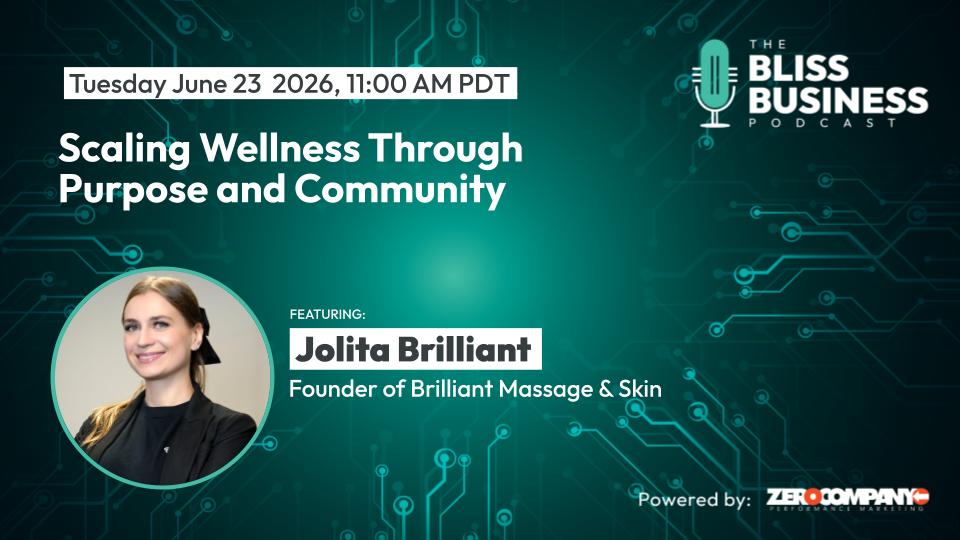
Scaling Wellness Without Losing the Human Touch

Many businesses begin with one person solving a problem, serving a client, and developing a craft. But if the business is going to grow, the founder eventually has to make a difficult transition: from doing the work to building the systems, team, culture, and leadership that allow the work to scale.
That transition is especially challenging in wellness, where the value of the business is deeply connected to personal care, trust, and the relationship between practitioner and client.
On The Bliss Business Podcast, we sat down with Jolita Brilliant, Founder of Brilliant Massage and Skin and author of From Solo Therapist to Spa Empire, about what it actually takes when scaling a wellness business. Jolita began as an independent massage therapist in Burlington, Vermont in 2017 and has grown Brilliant Massage and Skin into a multi-location wellness brand offering customized massage therapy, skincare, and related services, with a franchise location operating in Stowe.
Her journey from classical piano in Lithuania to wellness entrepreneurship in the United States is a story of resilience, reinvention, and purpose.
From Practitioner to Entrepreneur
Jolita did not enter massage therapy intending to build a spa brand. At first, she saw it as a part-time path while figuring out what came next after stepping away from music. But the demand grew quickly. She became effective at marketing herself, and soon she had more clients than one person could serve.
That was the turning point.
A solo practitioner can only scale time so far. The next step required hiring, learning systems, building processes, and shifting from doing all the work personally to creating an environment where others could deliver excellent care too.
That shift is where many talented practitioners struggle. They were trained to serve clients, not necessarily to manage people, finances, marketing, operations, and growth.
Jolita learned that becoming a business owner requires a different mindset. You are no longer paid only for the hour you perform. You are rewarded for the value you create, the people you employ, the clients you serve, and the systems you build.
Resilience Changes the Way You See Risk
Jolita’s personal story adds depth to her entrepreneurial journey. She lost her mother to cancer when she was sixteen, then lost her father suddenly when she was nineteen. Those experiences shaped her relationship with wellness, prevention, and courage.
Rather than turning toward destructive coping patterns, Jolita became more interested in health, nutrition, movement, and preventative care. Her parents’ deaths became a painful but powerful reminder that life is fragile and time is not guaranteed.
That perspective carries into entrepreneurship.
When you have lived through real loss, business risk looks different. Failure is difficult, but it is not final. Mistakes are painful, but they can be repaired. If you are alive, you can learn, adjust, and try again.
That resilience became part of how Jolita built her business.
Wellness Professionals Should Not Undervalue Their Work
One of the most important parts of the conversation was Jolita’s perspective on money.
Many wellness professionals are deeply empathetic. They want to help people. But sometimes that desire to serve becomes tangled with guilt around charging, earning, or building wealth. Jolita challenged that mindset directly.
There is nothing selfish about charging fairly for valuable work. Wellness professionals have families, bills, goals, and communities to support. A healthy business allows them to serve more people, create jobs, and build stability.
As Jolita put it, growing a business does not mean stealing from others. When value is exchanged honestly, everyone benefits. Clients receive care. Practitioners earn a living. Communities gain access to services. Employees gain opportunity.
A rising tide can lift the whole community.
Scaling Care Requires Systems
A solo practitioner can maintain quality through personal attention. But once a business grows, quality has to be protected through systems.
Jolita shared that one of her goals in scaling was to maintain a strong reputation across locations. That requires clear processes, customer feedback, team training, and the flexibility to make things right when something goes wrong.
In service businesses, mistakes will happen. A schedule may get confused. A tool may be missing. A client may have a unique circumstance. The question is not whether every moment will be perfect. The question is whether the team has the permission and judgment to respond with care.
Brilliant Massage and Skin empowers team members to resolve issues, offer appropriate discounts or add-ons, and escalate when needed. That kind of flexibility protects trust.
Rigid policies may feel efficient, but they can damage relationships. Care-based businesses need systems, but those systems must leave room for humanity.
Bespoke Care Needs Consistent Standards
Brilliant Massage and Skin differentiates itself through customized care. Jolita refers to the brand’s services as brilliant bespoke massage and brilliant bespoke facials. The goal is not to treat every client the same. The goal is to provide the right care for each person.
That creates an important tension in scaling.
Franchise systems need consistency. Wellness care needs personalization.
Jolita resolves that by trusting licensed professionals while giving them strong guidelines, intake processes, and training. A client may book deep tissue, but once the therapist begins the session, they may realize the client’s pain tolerance requires a different approach. A facial may be focused on acne, but the esthetician may need to adjust the products or mask based on the client’s skin that day.
The system provides the framework. The practitioner brings professional judgment.
That is how personalization can scale without becoming chaos.
Technology Should Protect Human Presence
Jolita is also focused on technology and automation, especially for tasks that do not require human touch.
Booking, reminders, directions, review requests, marketing systems, and other administrative functions can be automated. The purpose is not to make the wellness experience feel robotic. The purpose is to free the team to focus on what cannot be replaced: presence, care, touch, energy, and personalized service.
This is the right use of technology in wellness. Automate the mundane so humans can be more human where it matters most.
Culture Has to Be Maintained Intentionally
As the business grew, Jolita learned that culture does not maintain itself.
Brilliant Massage and Skin uses weekly team Zoom calls to celebrate wins, discuss reviews, talk through challenges, reinforce best practices, and keep the team connected.
That matters because many practitioners choose to work in a team environment because they want support, connection, and shared learning. If the company does not intentionally create that, people can feel isolated even inside a growing organization.
Culture is not a one-time announcement. It is a repeated rhythm.
Community Drives Loyalty
When asked what role community plays in client loyalty, Jolita emphasized local connection.
Reviews, referrals, Chambers of Commerce, local events, charity gift cards, and community visibility all matter. People want to support local businesses, but they have to know the business exists and trust what it stands for.
For a wellness business, community is not only a marketing channel. It is part of the service promise. Clients are more likely to return and refer others when they feel the business is connected to the life of the community.
Franchising as a Path to Purpose
Jolita chose franchising because she believes it can help more wellness professionals become business owners without having to figure everything out alone.
A franchise gives owners a proven system, brand infrastructure, marketing support, technology, call center access, mentorship, and operational guardrails. It reduces trial and error and gives owners a blueprint they can adapt to their local market.
But Jolita was also clear: franchising does not mean everything is done for you. Owners still have to show up, learn the services, hire well, engage with contractors, choose locations, lead teams, and become known in their local market.
The system creates support. The owner creates local trust.
Local Ownership Creates Belonging
Wellness businesses become trusted parts of their communities when owners are visible.
Jolita encouraged franchise owners to show their face, tell their story, visit other businesses, attend local events, and share why they believe in the services. A franchise may provide the brand, but the local owner brings personality, leadership, and belonging.
People want to know who owns the business in their community. They want to know the values behind the location. They want to feel there is a real person creating the culture.
That is how a spa becomes more than a service location.
Love Makes the Work Sustainable
When asked what role love should play in business, Jolita answered from experience: you have to love what you do.
For her, that love shows up when clients arrive stressed or depleted and leave smiling. It shows up in creating a workplace where massage therapists and estheticians enjoy working. It shows up in handling setbacks with patience because the work matters enough to keep going.
Love does not remove the difficulty of business. It helps founders stay committed when things are hard.
Just like any meaningful relationship, business will have challenges. If you love the purpose behind it, you are more likely to repair, learn, and continue.
Key Takeaways
-
Scaling a wellness business requires moving from practitioner mindset to entrepreneur mindset.
-
Resilience changes how founders relate to risk, setbacks, and reinvention.
-
Wellness professionals should not feel guilty about charging fairly for valuable care.
-
Systems are necessary to protect quality as a care-based business grows.
-
Bespoke care can scale when licensed professionals are supported by clear frameworks and training.
-
Technology should automate administrative tasks so humans can focus on presence and care.
-
Culture needs regular rhythms, not occasional reminders.
-
Franchise owners build belonging by being visible and active in their local communities.
Final Thoughts
Jolita Brilliant’s story is a reminder that scaling wellness does not mean losing the personal touch. It means building the systems that allow personal care to reach more people.
The best wellness brands do not choose between consistency and customization. They create frameworks that protect quality while giving practitioners room to respond to the person in front of them.
When purpose, systems, culture, and love come together, a solo practice can become something much larger: a community of care.
Where to Go Next
Listen to the full conversation: Scaling Wellness Through Purpose and Community with Jolita Brilliant.
Watch the video: Jolita Brilliant on wellness franchise systems.
Meet Jolita on her guest profile.
See how another founder scales personal-care services through franchising: Beauty in Scale with Meg Roberts.

Executive Producer | Host | Blog Contributor
Tullio Siragusa is a strategic advisor, dynamic speaker, author, and EQ coach with 36 years of experience as a technology disruptor rooted in Design Thinking. Since 2018, he has been creating, producing and hosting live podcasts, interviewing over 1,000 C-suite executives across a wide range of industries. His work behind the mic reflects his larger mission: using conversation as a catalyst for human-centric innovation.
Tullio’s commitment to purpose-driven leadership and ethical transformation is reflected in his advisory roles at the University of California, Riverside’s Design Thinking Executive Program, and the University of San Francisco School of Management’s Digital Marketing Program. As a Board Advisor at AI2030.org, he helps guide the responsible advancement of AI toward ethical and sustainable outcomes. A founding member of RadicalPurpose.org, Tullio believes empathy isn’t just a trait, it’s a non-negotiable foundation for leadership.

Belonging Is a Business Strategy