Growth Happens When Marketing Stops Working Alone

Marketing and business growth are often discussed as if they are naturally connected.
They are not.
A marketing team can hit its targets while the business misses its own. Lead volume can rise while close rates fall. Campaigns can look healthy while operational capacity is strained. A franchise location can feel extremely busy while profitability quietly deteriorates.
That disconnect is one of the most important challenges modern marketing leaders have to solve.
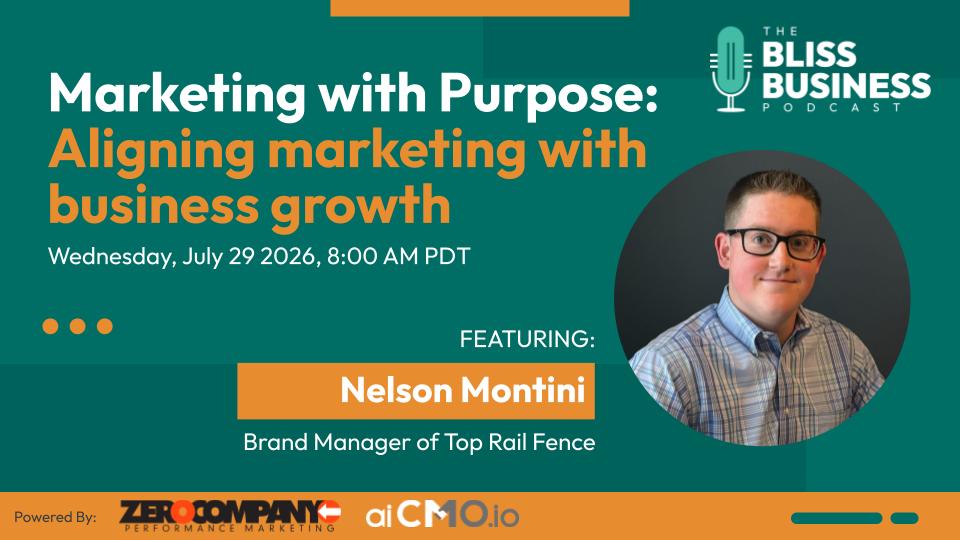
In a recent conversation with Nelson Montini, Brand Manager at Top Rail Fence, on the Marketing with Purpose series of The Bliss Business Podcast, that idea came through with unusual clarity. Nelson’s experience across franchise systems has taught him that the strongest marketing organizations replace the familiar “marketing versus operations” dynamic with something much more productive: marketing with operations, marketing with finance, and marketing with the broader business.
That shift sounds small, but it changes the role of marketing completely.
Instead of optimizing for its own scorecard, marketing begins optimizing for the health of the business.
A Green Marketing Dashboard Can Still Hide a Business Problem
One of Nelson’s strongest points is that marketers can make the technically correct decision and still make the wrong business decision.
Imagine lead volume is below target. The marketing team responds exactly as expected. It increases spend, improves campaigns, and gets the metric back on track. Three weeks later, the dashboard is green.
But what if operations has lost capacity?
What if sales is short-staffed?
What if appointments are already backed up?
In that case, marketing has successfully solved its own problem while making the business problem worse.
This is why functional metrics need to be interpreted in context. A strong marketing leader has to understand what happens downstream from the lead, not simply whether the lead was generated.
That means asking whether the operation can handle more demand, whether sales can respond quickly enough, and whether the additional volume is creating profitable growth or just more pressure.
The lesson is simple: performance should not be defined by the health of the marketing department. It should be defined by the health of the business.
Marketing Alignment Starts with a Shared Definition of Winning
Nelson talks about the importance of moving from task alignment to purpose alignment.
That distinction matters.
A team can agree on what needs to be done and still disagree about what success looks like. Product may launch new features. Sales may introduce a new process. Marketing may build a campaign around a different message. Everyone is busy and everyone is contributing, but the pieces do not necessarily add up to the same outcome.
Nelson’s approach is to begin with a vivid picture of the goal.
What does the business actually want to achieve? What does success look like when it is fully realized? What role should each function play in getting there?
That kind of clarity gives teams something larger than a checklist. It helps them understand why the work matters and how their decisions affect one another.
In franchise systems, where local markets, owner behavior, and operational readiness can vary widely, that shared vision becomes even more important. Without it, each location or department can optimize in isolation and unintentionally create friction elsewhere.
The Best Marketing Leaders Look One Step Further Downstream
One of the most practical ideas in the conversation is Nelson’s habit of looking beyond the immediate marketing outcome.
If booking rate is weak, investigate it.
If close rate is slipping, understand why.
If reviews are deteriorating, look for the operational pattern underneath them.
This is where marketing leadership becomes business leadership.
Nelson shared an example from Top Rail Fence where top-line performance initially looked excellent. Lead volume was strong, revenue was growing, and same-store sales looked healthy. Then small warning signs began to appear. Close rates dipped. One-star reviews started showing up. At first, those changes looked minor.
Once the team examined the customer feedback more closely, the real issue became clear: response time.
The faster customers were reached, the more likely they were to close. A delay of several days created a steep decline in conversion. What might have been diagnosed as a sales coaching problem was actually a capacity and customer-experience issue.
That distinction matters enormously.
The wrong diagnosis would have led to more sales training.
The right diagnosis led to a better understanding of how quickly the business needed to serve demand.
This is what strong cross-functional marketing looks like in practice. It follows the signal until it finds the real constraint.
More Leads Can Make a Business Worse
This may be one of the most important lessons for growth-stage companies.
More demand is not always helpful.
If a franchise owner does not have enough people to respond, sell, install, or serve, increasing marketing investment can actually damage profitability. The business becomes busier, response times get longer, close rates weaken, reviews decline, and customer experience suffers.
Nelson describes this challenge clearly in the franchise context. Owners often want to accelerate growth by spending more, especially when the current system appears to be generating demand predictably. The instinct is understandable. If the engine is working, why not add more fuel?
Because the rest of the business has to be ready for it.
This is why marketing spend should be tied to operational capacity. Growth works best when demand generation and service capacity expand together. Otherwise, the business can end up paying more to create opportunities it is not equipped to convert.
That is not growth.
It is congestion.
Customer Feedback Often Reveals What the Scorecard Misses
Nelson’s close-rate example also shows why qualitative customer feedback matters so much.
The numbers showed a decline.
The reviews explained it.
This is a recurring pattern in good marketing organizations. Analytics reveal that something changed, but customers often reveal the reason.
A scorecard can tell you that close rate fell. It cannot always tell you that customers felt ignored. It can show that conversion weakened, but not necessarily that people were frustrated by delayed responses.
That is why leaders should resist the temptation to treat data and customer insight as competing forms of truth. The strongest decisions come from combining them.
Data identifies the pattern.
Human feedback adds context.
Together, they create a much stronger diagnosis.
Crisis Leadership Is Also Communication Leadership
Nelson shared another strong example from an earlier franchise brand where the company discovered its website had been effectively shadow-banned by Google, cutting off both paid and organic traffic.
That is the kind of crisis that can quickly erode confidence across a franchise system.
The instinct in those moments is often to disappear into problem-solving mode and emerge once the issue is fixed. Nelson argues that this is a mistake.
Even excellent work behind the scenes does not preserve trust if the people depending on the system do not know what is happening.
His approach was built around three principles: clear, confident communication. Franchise owners were updated every week on what the team knew, what remained uncertain, and what was being done next.
That kind of transparency matters because uncertainty creates its own story if leadership does not provide one.
People fill gaps with assumptions.
Those assumptions harden into beliefs.
Trust becomes much harder to rebuild later.
Communication is therefore not separate from crisis management. It is part of the solution.
Marketing Should Develop People, Not Just Campaigns
Nelson makes an important distinction between being a strong marketer and being a strong marketing leader.
A marketer may be excellent at SEO, content, social media, paid media, or another specialized function. A leader has a different responsibility: helping people understand how those disciplines connect to the business.
That difference is crucial.
When team members understand only the tactic, their career ceiling stays relatively low. When they understand how the tactic influences revenue, profitability, customer experience, and growth strategy, they begin thinking like business leaders.
That creates better work and stronger talent.
It also gives people more meaning.
A team member who understands the business impact of their work is more likely to make better decisions, challenge weak assumptions, and contribute ideas that extend beyond their immediate task list.
Purpose, in this sense, is not abstract.
It is understanding why the work matters.
Empathy Changes the Marketing Decision
The most powerful example in Nelson’s conversation comes from a franchise owner who was investing aggressively in marketing but losing money.
After roughly sixty days, the owner had spent significantly more on marketing than the business had closed in revenue. From a pure lead-generation standpoint, marketing could have continued doing its job and pointing to activity.
Nelson’s team made a different decision.
They reduced marketing investment, focused on the sales process, improved close rates over time, and only then began increasing spend again. Eventually, the location started producing much stronger months consistently.
That is a great example of marketing with empathy because the decision was not based on protecting the marketing scorecard.
It was based on protecting the franchise owner.
In franchising, that matters deeply. Owners often have savings, retirement funds, and their family’s financial future tied to the success of the business. Treating marketing only as a lead-generation function ignores that human reality.
The better question is whether the marketing decision helps the owner build a healthier business.
That is where purpose becomes operational.
Alignment Is What Turns Marketing Into a Growth System
Nelson’s perspective ultimately points toward a broader truth.
Marketing becomes more valuable as it becomes less isolated.
When it works closely with operations, it understands capacity.
When it works with sales, it understands conversion.
When it listens to customers, it understands experience.
When it works with finance, it understands profitability.
That is when marketing stops being a channel function and starts becoming part of the operating system of the company.
This is also where the B.L.I.S.S. philosophy—Building Love Into Scalable Systems—fits naturally. Love in business is not about lowering standards. It is about making decisions with a fuller understanding of the people those decisions affect.
In a franchise system, that means building systems that help owners grow sustainably rather than simply generating more activity for them to manage.
Key Takeaways
Marketing performance should be judged by business outcomes, not isolated scorecards. A campaign can hit its target while creating problems elsewhere in the organization.
Shared goals matter more than shared tasks. Cross-functional teams need a clear picture of what the business is trying to achieve before execution begins.
Strong marketing leaders follow the signal downstream. Booking rates, close rates, reviews, and customer experience can reveal constraints that marketing metrics alone cannot.
More demand is not always better. Marketing investment has to stay aligned with operational capacity or additional leads can reduce profitability.
Customer feedback adds context to analytics. Quantitative data shows where something changed; qualitative feedback often reveals why.
Crisis communication protects trust. Clear, confident updates keep uncertainty from turning into damaging assumptions.
Empathy leads to better commercial decisions. The best marketing choice is not always the one that maximizes lead volume; sometimes it is the one that protects the health of the business.
Final Thoughts
What this conversation with Nelson Montini, Brand Manager at Top Rail Fence, makes clear is that aligning marketing with business growth requires a broader definition of marketing leadership.
The job is not simply to generate demand.
It is to understand whether the business can absorb that demand, convert it, serve it well, and turn it into sustainable profit.
That requires marketers to work across functions, stay close to the customer experience, and remain willing to change course when the broader business says the current approach is not working.
When that happens, marketing stops being a department fighting for credit.
It becomes a partner in how the company grows.

Guest Development | Producer | Blog Contributor
Martha is a connector who brings over two decades of experience in engineering, sustainability, education, and public relations. She is part of the integrated go-to-market team at Zero Company and serves as Guest Development Lead for The Bliss Business Podcast, where she connects with purpose-driven leaders to shape meaningful conversations. Martha also produces the Marketing With Purpose Kit segments with CMO guests.
Her career includes founding nonprofits, and speaking at global forums in Malaysia, Dubai, and Paris. A passionate community builder, Martha also mentors women entrepreneurs and supports environmental initiatives across Mexico and the U.S. Her work reflects a deep commitment to impact, inclusion, and authentic leadership.

Starting Over Deserves Community