
Marketing With Purpose Kit: Bringing Purpose and Empathy into Marketing
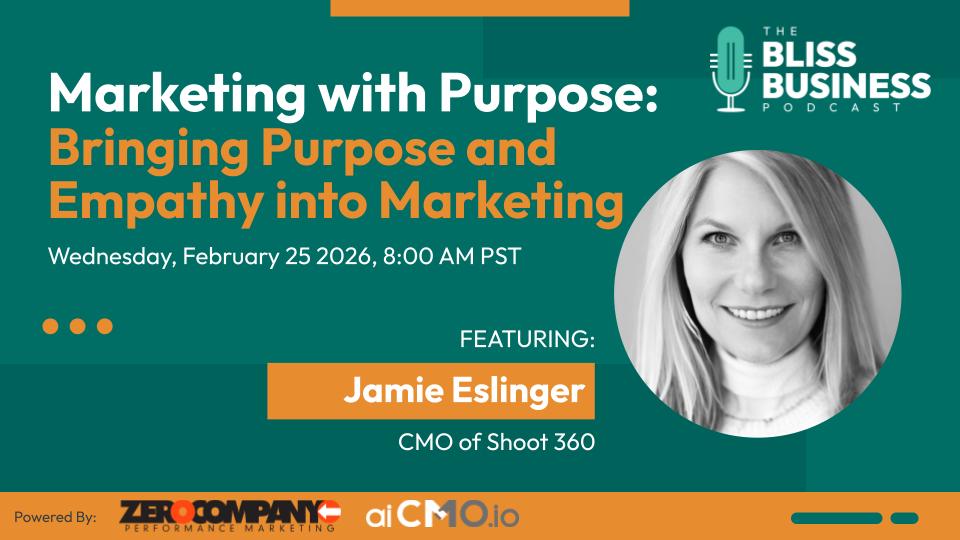
Jamie Eslinger, Chief Marketing Officer of Shoot 360, joins the Marketing With Purpose series to talk about the brand manifesto she wrote in her first months on the job, and why a brand with the best technology in its category still needed a better story to stop being a secret.
A brand manifesto was the first thing Jamie Eslinger built when she arrived at Shoot 360, because the brand had every logical proof point and no story anyone could repeat. Jamie is Chief Marketing Officer of Shoot 360, an Entrepreneur Top 50 Franchise CMO Game Changer, and a former collegiate basketball player with more than 20 years across startups, international retail, and franchise brands including Baskin-Robbins, Massage Envy, and European Wax Center. She joined host Mike Liwski on the Marketing With Purpose series.
In this episode we explore:
• Turning the best kept secret in a category into a story people repeat
• Writing a brand house and a manifesto in the first months of a CMO role
• Staying human when a product crisis forces fast decisions
• Letting customer behavior finish an idea the team started
• Why communication, not project management, decides a launch
• Franchisees as the earliest signal of a new revenue category
Jamie’s starting diagnosis is one a lot of marketers will recognize. Shoot 360 had the most locations, the best technology, NBA and WNBA investors, and more than 30 patents. The mechanics were solid. What it did not have was a reason to care, and the phrase she kept hearing internally was that the company was the world’s best kept secret in basketball. Her response was blunt: then that is my job.
The manifesto she wrote is titled Everyone Gets a Shot, and it works because it operates on two levels at once. On the surface it is about basketball. Underneath it is about confidence, because every shot you take builds a little more of it. That reframing widened what the brand is selling without loosening what it actually does, which is the hardest trick in positioning.
On crisis, she is equally practical. She traces the lesson back to being a young brand manager at Baskin-Robbins when machinery failed and metal fragments reached a production line. Her boss did not start with the press statement. He started with the people the decision would touch: franchisees, customers, vendors, teams. Her conclusion is that you can still build trust in a hard moment if the human element stays in the foreground, because everyone understands a tough call, and almost no one forgives a cold one.
The best operating story is the one where the customer finished the product. Shoot 360 launched a new competitive format called Leagues, ran the testing, got good feedback, and then heard the same thing on call after call with real leads: people wanted to play alone first. The team reformatted the game, renamed it 3Ball, and built a solo version and a trios version. The idea was not wrong, it was incomplete. That is the loop Zero Company runs on paid media too, where the market tells you what the creative brief could not.
Key Takeaways
• (3:24) The problem she inherited, in the company’s own words: Shoot 360 was “the world’s best kept secret in basketball.” Her reaction: “then that’s my job to not be that anymore.”
• (5:49) The manifesto is titled Everyone Gets a Shot, and it stretches past the category: “when you take a shot, it builds confidence, and the more shots you take, the more confidence it builds.”
• (9:36) The Baskin-Robbins lesson, after metal fragments got into a production line: her boss taught her “we’re taking care of humans here,” franchisees, customers, and vendors before the statement.
• (14:49) Her test for any plan: “the consumer votes with their wallet every single day,” so the signals coming back are the real read on whether the strategy is landing.
• (17:09) After launching Leagues, customer calls revealed people wanted to play solo before forming a team. The game was reformatted and renamed 3Ball, with solo and trios formats: “of course, this is exactly what it should have been.”
• (22:17) On launches: “it always comes down to communication,” and the best communication is often “I don’t know, we’ll get back to you,” which only happens when people feel safe enough to say it.
FAQ
What is a brand manifesto and why does a brand need one?
A brand manifesto states the emotional reason a brand exists, beyond its features. Jamie Eslinger wrote one for Shoot 360 called Everyone Gets a Shot, which reframed the product from basketball training to confidence building.
How should a brand handle a product crisis?
Start with everyone the decision touches, not the statement. Jamie Eslinger learned this at Baskin-Robbins, where the priority was doing right by franchisees, customers, and vendors, which is what protects trust when the product cannot be defended.
How do you know when to change a product after launch?
Listen for the same objection repeating. Jamie Eslinger’s team heard from lead after lead that people wanted to play solo before joining a team, so they reformatted and renamed the product rather than abandoning the concept.
Great marketing does not just sell, it serves. Hear the full conversation with Jamie Eslinger, watch it on the video page, and find more on the Marketing with Purpose Kit series. Jamie is on LinkedIn and at shoot360.com.

CMO
Jamie Eslinger, named an Entrepreneur Top 50 Franchise CMO Game Changer, is a dynamic marketing leader with over 20 years of experience driving brand growth, innovation, and audience engagement across startups, international retail, franchising, and iconic global brands.
Currently Chief Marketing Officer of Shoot 360, Jamie leads marketing with a strong focus on digital lead generation, customer acquisition, and local market engagement.
Jamie began her career in sports marketing with the WNBA, NBA, and NHL at Washington Sports and has held key marketing leadership roles at The Little Gym, PartyLite, and Baskin-Robbins. As CMO at JEM Brands she lead their Crunch Fitness, Massage Envy, and European Wax Center franchise locations across the U.S. Throughout her career, she has led cross-functional teams, large-scale initiatives, and transformative brand strategies that deliver measurable results.
Known for combining strategic rigor with creative flair, Jamie has built award-winning campaigns — including a Gold Reggie Award for her work with Yahoo.com and Baskin-Robbins — and is recognized for expertise in digital marketing, lead generation, PR, grassroots promotions, and change management. Her work has consistently increased brand awareness, customer engagement, and franchisee success.
Jamie’s work has been featured in Marie Claire magazine, and she is passionate about mentoring emerging professionals and giving back through community initiatives, including Komen for the Cure.
Outside of work, Jamie enjoys pickleball, yoga, a good spa day, and spending time w… Read More

