Connection Is the Experience

Some of the most memorable experiences in life happen when we encounter someone whose world looks different from our own. It might happen over a meal, in an unfamiliar neighborhood, through a conversation with someone we never expected to meet, or in a moment when a stranger makes us feel unexpectedly welcome. Those experiences stay with us because they do more than entertain us. They expand our perspective and remind us that despite differences in geography, language, culture, or circumstance, most people are looking for remarkably similar things. We want to feel seen. We want to feel connected. We want to belong somewhere, even if only for the length of a meal or a conversation.
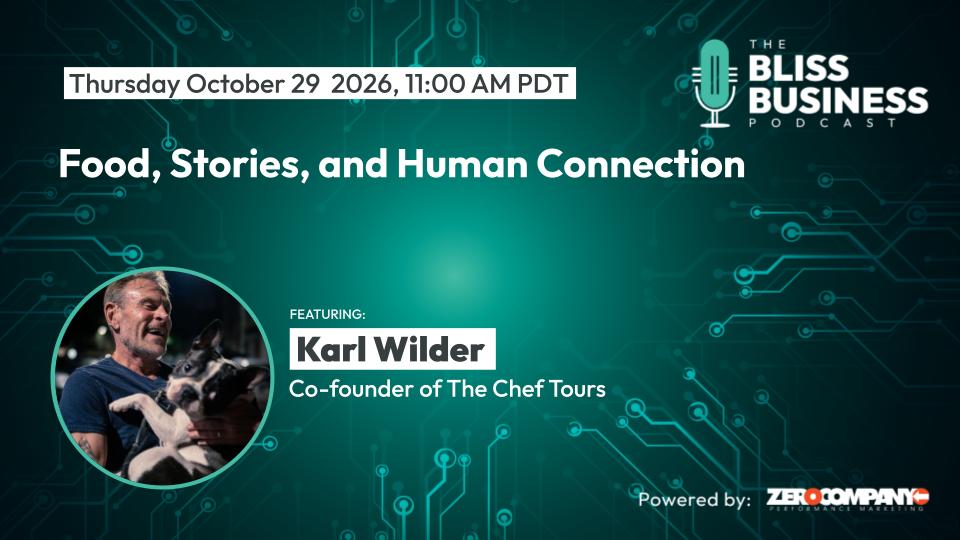
On The Bliss Business Podcast, we sat down with Karl Wilder, chef, author, entrepreneur, and Co-Founder of The Chef Tours, to explore the relationship between food, travel, storytelling, hospitality, and human connection. Through The Chef Tours, Karl creates small-group culinary experiences led by local chefs who introduce travelers to the people, neighborhoods, traditions, and stories that make each destination unique. He also serves on the board of Secret Street Tours in Dublin, an organization that gives people affected by homelessness an opportunity to share their perspectives of the city.
What became clear throughout our conversation is that food may be the invitation, but connection is the real experience.
Food Creates a Doorway Into Someone Else’s World
Travel is often built around difference. We visit another country because we want to experience a different language, culture, history, or cuisine. Yet Karl’s years of traveling, cooking, and hosting people around the world have led him to believe that people are far more alike than we sometimes imagine. Most people want a good life. They want meaningful relationships. They want safety, dignity, laughter, and something worth looking forward to. They want to enjoy a meal with people they care about.
That is why food creates such an effective bridge. A meal gives people something immediate to share. You may not speak the same language or come from the same background, but you can still understand generosity when someone places a dish in front of you that took hours to prepare. You can understand pride when someone explains a recipe passed through generations. You can understand hospitality when someone welcomes you into a place that matters to them.
Karl built The Chef Tours around that idea. He is not interested in simply taking people from one famous food stop to another so they can check items off a list. The goal is to help travelers experience a city through the people who actually live there.
In Mexico City, for example, guests may find themselves in an industrial neighborhood most tourists would never visit. They walk behind the main road into a small local eatery where a grandmother prepares mole for the group. Her children and grandchildren are part of the restaurant. There may be no large social media presence, no tourist marketing machine, and no spot on a typical “Top Ten Places to Eat” list. What makes the experience special is that the place is known and loved by the community itself.
That is a very different kind of tourism. Instead of consuming a destination, you are being invited into someone’s world.
Stories Are What Make Experiences Last
We tend to think unforgettable hospitality requires extravagance. Karl’s experience suggests the opposite. What people often remember most are the stories surrounding the experience.
On his Berlin tours, Karl shares pieces of his own family history, including stories about his grandparents and their journey from Germany to America. He talks about returning to Germany and sometimes cooks with his grandfather’s cast-iron skillet. The meal becomes connected to something larger than the ingredients.
That is the power of storytelling. Food is transformed from something consumed into something understood. A dish can be technically excellent and still fade from memory. But when someone tells you who taught them to make it, why their family served it, or what the neighborhood surrounding the restaurant once meant to them, the experience becomes emotionally anchored.
Karl shared a remarkable example from Bangkok. On an early visit, he ate at a small food stand and spent part of the afternoon playing ball with the owner’s young son. A photograph was taken of them together. Twenty years later, Karl returned to Bangkok and heard someone calling after him. It was the boy, now grown, who recognized him. The photograph of them playing together was still there.
The meal had been memorable, but the relationship was unforgettable. That story also reveals something important about travel and hospitality. We often think only about the impact a destination has on us. We rarely consider the impact we may have on the people we meet. Connection flows both ways.
Hospitality Is the Art of Making People Feel Seen
Karl credits much of his philosophy of hospitality to his mother. He joked that she was not necessarily the greatest cook, but she knew how to make everyone who entered her home feel important. That may be the essence of hospitality. It is not perfection. It is presence.
We all know the feeling of returning to a restaurant or café where someone remembers us. Tullio shared the example of a restaurant in Santa Monica where a server named Inga knew what he and his wife liked so well that their favorite drinks and other items would begin appearing before they had even ordered.
Karl described a similar experience at a coffee shop in Paris. After returning enough times, the staff knew him and began preparing his coffee when he walked in. Those moments matter because they transform a transaction into recognition. Instead of feeling like the next customer, you feel known.
That is also why Karl encourages travelers not to obsess over novelty. If you find a café you love, go back. If you meet someone interesting, return and continue the conversation. If you find a neighborhood that feels meaningful, spend more time there. Modern tourism often rewards volume, but depth creates a different kind of memory. You stop merely seeing the place and start becoming connected to it.
Businesses can learn from this. Customer experience is often discussed in terms of efficiency, personalization technology, and loyalty programs. Those things have value, but there is still something extraordinarily powerful about genuine recognition. People remember when they feel seen.
Scale Should Protect Authenticity, Not Remove It
The Chef Tours operates in very different cities, including Paris, Berlin, Seville, Istanbul, Mexico City, and Buenos Aires. The traditional business instinct would be to standardize the experience so every market operates in almost exactly the same way. Karl deliberately chose another path.
There is a shared philosophy, but there is not a shared script. The local chef shapes the experience. The city shapes the food. The stories come from the person telling them. Karl supports the chefs, but he does not try to turn each tour into a replica of another location.
That is because the differences are the product.
If a Mexico City tour felt exactly like Berlin, something important would have been lost. Karl had previously worked with larger tour companies that relied more heavily on standardized formats. His response was to build a model where the city itself could define the experience. That means selecting the right chef becomes incredibly important. The person has to understand hospitality intuitively. They need to care about their community and want visitors to experience the real city rather than simply the most marketable version of it.
This is a useful lesson for any business trying to scale human experiences. Consistency is valuable, but leaders need to be clear about what should actually be consistent. The purpose can be consistent. The values can be consistent. The standard of care can be consistent. The experience itself does not always need to be identical.
Sometimes excessive standardization removes exactly what customers came to experience.
Connection Can Restore Something Society Has Taken Away
Karl’s work with Secret Street Tours in Dublin brings an even deeper dimension to the idea of connection.
The organization creates opportunities for people who have experienced homelessness to lead visitors through the city and share it from their own perspective. Karl first took one of the tours about eight years ago and never forgot it. When an opportunity later arose to join the board, he wanted to help.
One thing he has learned is how easily people experiencing homelessness become invisible. People walk around them, avoid looking at them, and stop asking questions. Eventually, a person can begin to feel as though society no longer sees them at all.
Karl talked about stopping to speak with people living on Dublin’s streets and allowing them to spend time with his service dog. One man he met was struggling with homelessness and substance use. Karl encouraged him to consider rehabilitation and listened to his story. Later, the man recognized Karl on the street and proudly told him he had completed rehab, attended his son’s wedding, found part-time work, and moved into transitional housing.
We can never know exactly what part one conversation plays in another person’s journey, but we know what disconnection does. Human beings need recognition. We need someone to see possibility in us, particularly when we are struggling to see it ourselves.
This is why social impact does not always begin with enormous programs. Sometimes it begins when someone refuses to look away.
Love in Business Begins With Paying Attention
When we asked Karl what role love should play in business, he said it should play the leading role. That does not mean abandoning profitability. The Chef Tours still has expenses. Chefs need to make money. Operations have to work. It means deciding what the business exists to create beyond the transaction.
Karl’s definition of success is increasingly connected to relationships. Can you connect with someone from another culture? Can you learn from someone whose life looks nothing like yours? Can you make another person feel seen? Can your business create an experience people remember because of how they felt rather than simply what they purchased?
Those are meaningful measures of success.
Karl’s practical advice for leaders wanting to become more empathetic is equally simple: listen. Listen not only to what people say, but to what they are trying to communicate. Pay attention to their stories. Put yourself in environments where you meet people different from those you normally encounter.
Empathy becomes difficult when we remain inside echo chambers. It becomes much easier when we encounter real people. The more we experience one another directly, the harder it becomes to reduce people to stereotypes, categories, customer segments, political identities, or economic value.
They become human again.
Key Takeaways
-
Food creates a natural doorway for people from very different backgrounds to connect.
-
The most meaningful travel experiences often come from participating in local life rather than merely observing it.
-
Stories transform meals and places into emotional memories.
-
Hospitality is less about perfection and more about helping people feel recognized, welcomed, and valued.
-
Returning to the same people and places can create deeper experiences than constantly pursuing novelty.
-
Businesses can scale around a shared purpose without scripting every interaction or forcing every location to look identical.
-
People experiencing homelessness often lose a sense of visibility and human connection, making simple recognition meaningful.
-
Social impact begins with understanding what you genuinely care about and finding a way to act on it.
-
Empathy grows when we deliberately put ourselves in contact with people whose experiences differ from our own.
-
Love in business begins with caring enough to listen, understand, and create experiences that matter beyond the transaction.
Final Thoughts
Karl Wilder’s work is a reminder that the experiences we carry with us longest are rarely defined only by what we consumed, where we stayed, or what attraction we visited. They are defined by the people who made us feel welcome, the stories that changed how we saw a place, and the moments when we stopped being observers long enough to become participants.
That lesson applies just as powerfully to business. Companies spend enormous amounts of time and money trying to create memorable customer experiences, yet some of the most meaningful moments still come from very simple human behaviors. Someone remembers your name. Someone listens carefully. Someone shares something personal. Someone makes you feel like you belong rather than making you feel like the next transaction.
The same principle applies to how we see people who are often ignored. Connection begins when we are willing to be present with another person without immediately reducing them to a category, circumstance, or economic value. That kind of presence builds empathy because it exposes us to stories that cannot be captured in demographics or customer data.
Food may bring people to the table, but the table was never really the point. The people around it were. And whether we are designing a travel experience, building a company, serving a customer, or simply moving through the world, the ability to make another person feel seen may be one of the most valuable things we can offer.
Check out our full conversation with Karl Wilder of The Chef Tours on The Bliss Business Podcast.

Executive Producer | Host | Blog Contributor
Tullio Siragusa is a strategic advisor, dynamic speaker, author, and EQ coach with 36 years of experience as a technology disruptor rooted in Design Thinking. Since 2018, he has been creating, producing and hosting live podcasts, interviewing over 1,000 C-suite executives across a wide range of industries. His work behind the mic reflects his larger mission: using conversation as a catalyst for human-centric innovation.
Tullio’s commitment to purpose-driven leadership and ethical transformation is reflected in his advisory roles at the University of California, Riverside’s Design Thinking Executive Program, and the University of San Francisco School of Management’s Digital Marketing Program. As a Board Advisor at AI2030.org, he helps guide the responsible advancement of AI toward ethical and sustainable outcomes. A founding member of RadicalPurpose.org, Tullio believes empathy isn’t just a trait, it’s a non-negotiable foundation for leadership.

When Space Works Better, Life Works Better