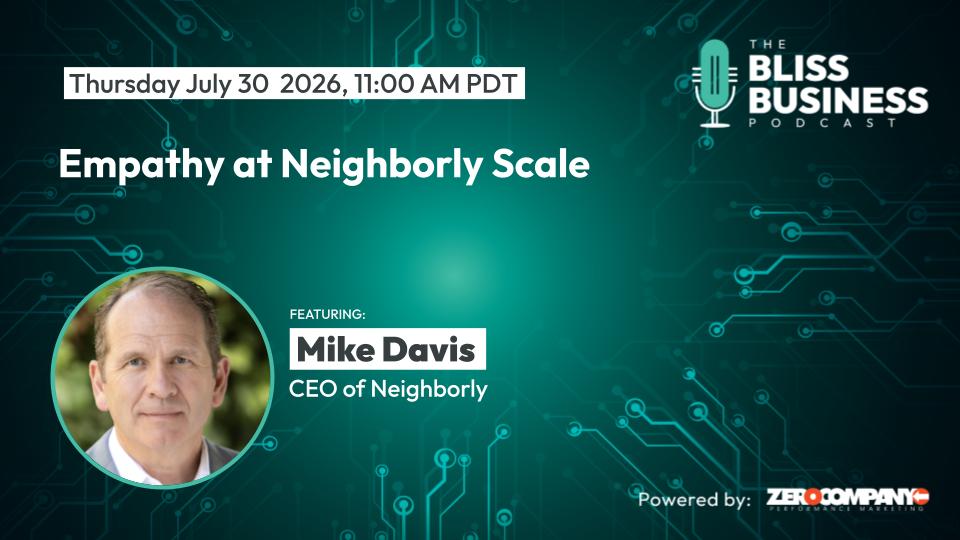
Empathy at Neighborly Scale
Home services are deeply personal.
When someone invites a professional into their home, they are doing more than purchasing a repair, maintenance visit, or installation. They are placing trust in a person, a brand, and the systems behind that service. That makes empathy more than a leadership value. It becomes part of how a company earns trust, supports franchise owners, strengthens teams, and creates service experiences people remember.
On The Bliss Business Podcast, we sat down with Mike Davis, CEO of Neighborly, to explore what empathy looks like at scale. Neighborly is the world’s largest home services company, with more than 30 brands and 5,500 franchise locations serving millions of customers through the repair, maintenance, and enhancement of homes and businesses. Mike joined Neighborly as CEO in July 2024 after leadership roles across franchising, consumer services, education, media, e-commerce, and digital platforms.
His message was clear: growth at scale requires more than systems. It requires believers. And believers are built through empathy, authenticity, trust, and accountability.
Growth Requires Believers
Most companies are focused on growth, and Neighborly is no different. But Mike made an important distinction. True growth engines are not built only through strategy, technology, capital, or operational discipline. They are built by teams of believers.
People need to believe in the mission. Franchise owners need to believe in the system. Technicians need to believe in the service experience. Customers need to believe that the company can be trusted inside their homes.
That belief is not created by command and control. It is created through empathy and authenticity. When people feel that leaders are honest, grounded, and genuinely connected to the work, trust grows. When trust grows, people care more deeply. When people care more deeply, execution improves.
Empathy is not separate from performance. It is part of what makes performance sustainable.
Values Need To Become Daily Practice
Neighborly has a long-standing Code of Values that originated with the company’s founder, Don Dwyer. Mike described it as a kind of fabric that connects thousands of owners across the system. Many franchise owners joined Neighborly in part because those values resonated with them.
That is important because values at scale cannot live only on posters or in onboarding materials. They have to become a shared operating language.
At Neighborly, those values are reinforced through training, meetings, office environments, franchise owner calls, and regular leadership communication. Mike also added guiding principles to help clarify not only how people show up, but what they do in practice.
That repetition matters.
Leaders sometimes get uncomfortable repeating the same message. They want to move on to something new. But if something is important, repetition is part of leadership. A value becomes real when people hear it often enough, see it modeled consistently enough, and experience it inside the systems of the business.
Empathy and Accountability Are Not Opposites
One of the most powerful ideas from the conversation was Mike’s belief that empathy does not slow execution. In fact, kindness can pour gas on execution.
Many leaders still believe that kindness and accountability are in tension. They assume that if they are too empathetic, performance will decline. They confuse compassion with lack of standards.
Mike rejects that idea.
Accountability comes from clarity, transparency, and consistency. Leaders can set ambitious goals, track performance, require excellence, and still treat people with dignity. The way accountability is delivered matters. It does not require fear, intimidation, or a stick.
In fact, when people believe the leader cares about them and the mission, they are often more motivated to hold themselves accountable. That is a stronger form of accountability because it comes from ownership, not compliance.
Kind Is Better Than Nice
Mike made another important distinction: being nice is not always the same as being kind.
In franchising, a franchisor may think it is being nice by avoiding difficult conversations with franchise owners. But if an owner’s performance is declining, avoidance does not help them. It may feel polite in the moment, but it is not kind.
Kindness tells the truth.
If a franchise owner was once performing well but is now slipping into the middle or bottom quartile, the kind conversation is the honest one. It says, “We care about your business enough to tell you the truth and help you improve.”
That kind of clarity is an act of care. It gives people the information they need to grow.
Sacred Places Require Sacred Trust
Home services are different because the work happens inside someone’s personal space.
Mike described homes as sacred places. That framing changes the work. When a technician enters a home, they are not simply fixing a faucet, repairing an air conditioner, treating a yard, or installing a garage door. They are stepping into the place where people live, raise children, care for loved ones, rest, gather, and feel safe.
That means the service experience has to carry a sense of respect.
Small details matter. Shoe covers matter. Mats matter. Timeliness matters. Tone matters. Listening matters. These are not cosmetic gestures. They communicate that the company understands the emotional significance of entering someone’s home.
The transaction may be a repair. The experience is trust.
The Real Job Is Often Beneath the Job
A customer may call because the air conditioning is broken. On the surface, the job is to fix the air conditioner.
But the deeper need may be that a child has allergies, an elderly parent is uncomfortable, a family is under stress, or the home has become unsafe. When technicians and franchise owners listen for the emotional driver behind the request, the service becomes more meaningful.
Mike shared that Neighborly’s sales process includes intentional attention to customer motives and emotional drivers. The goal is not only to solve the visible problem, but to understand why that problem matters to the homeowner.
That is empathy by design.
A company does not scale care by hoping people are naturally thoughtful. It scales care by building listening, curiosity, and human context into the process.
Technology Can Help Scale Empathy
Scaling empathy across thousands of franchise locations requires systems.
Mike described how Neighborly uses tools to help coach and evaluate customer interactions, including AI-enabled support that can listen to technician conversations and assess elements such as process adherence, speed, tone, and delivery.
That is a powerful use of technology.
The purpose is not to replace the human relationship. It is to strengthen it. Technology can create feedback loops, identify gaps, reinforce standards, and help teams improve how they show up in the home.
Empathy at scale requires both humanity and measurement.
Without humanity, the experience becomes mechanical. Without measurement, the company cannot know whether the experience is actually being delivered consistently.
Hospitality Belongs in Home Services
Although Neighborly is in home services, much of Mike’s language sounded like hospitality.
That is the right mindset.
Homeowners may not be coming to a hotel or restaurant, but they are still experiencing a service moment. They may be stressed, inconvenienced, frustrated, or uncertain. The company’s job is not only to complete the task, but to make the customer feel cared for throughout the process.
Mike referenced books like Unreasonable Hospitality and Fans First as part of the thinking that influences how Neighborly approaches service.
That makes sense because the goal is not only customer satisfaction. The goal is to make fans.
Fans are created when people feel something beyond the transaction. They feel listened to, respected, protected, and surprised by the level of care.
Purpose Exists at Every Level
Neighborly has many layers of purpose.
At the customer level, the work helps people feel safe, comfortable, and cared for in their homes. At the franchise owner level, the system supports small business ownership and local entrepreneurship. At the technician level, the business can create growth paths and life-changing opportunities.
Mike shared stories of people who began in frontline roles and moved into ownership or senior leadership. One especially powerful example involved the president of Molly Maid, whose mother came to the United States from Mexico, worked as a Molly Maid cleaner, became an owner, and whose son later joined the corporate organization and eventually led the brand.
That is more than a career story. It is a purpose story.
It shows how a franchise system can become a platform for mobility, dignity, and legacy.
Vulnerability Builds Trust
Mike believes vulnerability is imperative for leadership.
When he first spoke to thousands of people at a national convention after joining Neighborly, he told his personal story. He shared his background, including that his father was a plumber and that he came from a blue-collar household.
That kind of vulnerability matters because people want to understand who a leader is, not only what the leader expects.
When leaders share what shaped them, people have a better chance of connecting with them. It reduces distance. It humanizes authority. It gives people context for the leader’s decisions and priorities.
Vulnerability does not weaken accountability. It strengthens trust.
Accessibility Is a Leadership Signal
Mike also described accessibility as part of vulnerability.
He makes himself available to franchise owners and team members, responding to calls, texts, and outreach rather than hiding behind layers of distance.
That sends a message.
In large systems, people can easily feel far away from leadership. Accessibility tells them they still matter. It shows that the organization is not just a hierarchy, but a relationship network.
For a leader at scale, accessibility cannot mean solving every problem personally. But it can mean staying connected enough to hear the truth, see patterns, and remain grounded in the lived experience of the system.
Silence Is a Warning Signal
One of the most honest moments in the conversation came when Mike talked about his frustration when people do not tell him the truth.
When a leader presents an idea and hears only silence, it may not mean everyone agrees. It may mean people do not feel safe enough to challenge the idea.
Mike asks himself what he may have done to make people afraid to speak up. That level of self-reflection is rare and important.
Leaders who want truth must create the conditions for truth. They have to show that disagreement is not punishment-worthy. They have to prove that feedback will not be used against people later. They have to demonstrate that they actually want the answer, not just agreement.
Psychological safety is not created by saying, “Be honest.”
It is created by what happens after people are honest.
Love Looks Like Shared Insomnia
When asked what role love should play in business, Mike gave a practical answer.
At Neighborly, the leadership team talks about “shared insomnia.” Not as panic or fear, but as a shared passion for helping franchise owners succeed. It is the kind of care that keeps leaders thinking about how to do more, serve better, connect more dots, and help the system grow in healthy ways.
That is love in business.
It is not sentimental. It is commitment.
It is caring about whether franchise owners are healthy, whether technicians are supported, whether customers receive a great experience, and whether the organization is living up to its promises.
Love becomes practical when it shows up as responsibility.
Emotionally Rehiring People
Mike introduced a phrase worth remembering: emotionally rehire people.
People may stay employed by a company for years, but that does not mean they feel emotionally recommitted to it. Leaders have to create moments that remind people they are valued, seen, and appreciated.
That might be a thank-you note. It might be recognizing someone’s effort. It might be giving someone time to be with family. It might be paying attention to what matters personally to an employee.
These gestures do not always require large budgets. They require awareness.
A small act of care can create loyalty for decades when it tells someone, “You matter here.”
Listen With Intent
At the end of the conversation, Mike offered a practical habit for leaders: listen with intent.
Everybody is right from their own perspective. That does not mean every opinion is correct, but it does mean every opinion is coming from a lived experience that makes sense to the person holding it.
Leaders who listen with intent ask, “Why does this person believe what they believe?”
That question changes the conversation. It moves leaders from judgment to curiosity. It makes space for understanding before response.
At scale, listening with intent may be one of the most important leadership behaviors a company can practice.
Key Takeaways
-
Empathy helps build believers, and believers drive sustainable growth.
-
Values become powerful when they are repeated, modeled, measured, and practiced daily.
-
Kindness and accountability are not opposites. Kindness can strengthen execution.
-
Being kind sometimes means having honest conversations that being nice would avoid.
-
Home services require sacred trust because the work happens inside someone’s personal space.
-
The real job is often beneath the job, which means teams must listen for emotional drivers.
-
Technology can help scale empathy when it reinforces better human interactions.
-
Vulnerability and accessibility help leaders stay connected at scale.
-
Emotional rehiring keeps people connected to the company through intentional acts of appreciation.
-
Listening with intent helps leaders understand why people believe what they believe.
Final Thoughts
Mike Davis’ leadership philosophy is a reminder that empathy does not weaken a growth engine. It strengthens it.
Neighborly operates at a scale where care could easily become abstract. Thousands of franchise locations, millions of customers, dozens of brands, and countless daily service interactions could become a machine.
But Mike’s message is that the machine still has to be human.
The customer’s home is sacred. The franchise owner’s dream matters. The technician’s behavior shapes the brand. The values have to be lived. The feedback loops have to be real. The leader has to remain accessible. And the organization has to keep emotionally rehiring people through intentional acts of appreciation and care.
That is how empathy scales.
Not as a slogan, but as a system.
Check out our full conversation with Mike Davis of Neighborly on The Bliss Business Podcast.

Executive Producer | Host | Blog Contributor
Tullio Siragusa is a strategic advisor, dynamic speaker, author, and EQ coach with 36 years of experience as a technology disruptor rooted in Design Thinking. Since 2018, he has been creating, producing and hosting live podcasts, interviewing over 1,000 C-suite executives across a wide range of industries. His work behind the mic reflects his larger mission: using conversation as a catalyst for human-centric innovation.
Tullio’s commitment to purpose-driven leadership and ethical transformation is reflected in his advisory roles at the University of California, Riverside’s Design Thinking Executive Program, and the University of San Francisco School of Management’s Digital Marketing Program. As a Board Advisor at AI2030.org, he helps guide the responsible advancement of AI toward ethical and sustainable outcomes. A founding member of RadicalPurpose.org, Tullio believes empathy isn’t just a trait, it’s a non-negotiable foundation for leadership.

Empathy Is an Operating System