The Future of Work in the Age of Generative AI with Professor Joseph Fuller

Professor Joseph Fuller, Professor of Management Practice at Harvard Business School, joins The Bliss Business Podcast to explain how AI and workforce skills are changing together: why most AI experiments fail, how degree inflation could ease, and why social skills and purpose keep work human.
AI and workforce skills are now one conversation, and Harvard Business School’s Professor Joseph Fuller explains why. In this episode of The Bliss Business Podcast, Stephen Sakach, Mike Liwski, and Tullio Siragusa talk with Joseph, Professor of Management Practice at Harvard Business School, co-lead of the Managing the Future of Work Project, and founder and former CEO of Monitor Group (now Monitor Deloitte), about how generative AI will reshape work, leadership, and culture.
In this episode we explore:
• Why about half of Americans use AI, but more at home than at work
• Why most corporate AI experiments fail, from polluted data lakes to untrained staff
• How AI could ease degree inflation and widen who qualifies for a job
• Which social skills AI cannot automate, and why “context engineer” replaces “prompt engineer”
• Why leaders should move fast while staying human-centered
• How purpose and love keep AI-era work human
Joseph calls AI “the most important technology for big organizations since electricity,” yet companies are adopting it more slowly than the technology is improving. His reason: bolting AI onto the side of today’s processes does not work, so organizations have to rethink the work itself.
He also explains why so many experiments flop. Dirty data, staff who were never trained, and thin vendor support top his list, and he reminds listeners that nobody has used a technology like this before.
On hiring, Joseph describes degree inflation and how AI could help employers look past school, grade point average, and years of experience. As analysis gets automated, what remains are social skills, and he urges young professionals to build them, along with the context that makes AI output useful.
The conversation closes on purpose. He warns that AI follows the data, not your values, so people need to know the company stands for more than efficiency, and he shares what love looks like on a high-performing team.
Making new technology feel human to the people who use it is the same work Zero Company does when it helps brands connect with their audiences.
Key Takeaways
• (13:10) On the hidden cause of failed pilots: “There’s a kind of a dirty little secret in corporate America, and it’s called polluted data lakes.”
• (19:57) On what is left of a job as AI takes on analysis: “A lot of what’s left are what we call social skills.”
• (28:31) On moving fast without losing judgment: “So you have to be very cautious about being cautious.”
• (32:31) On the skill that replaces the prompt engineer: “That term is going to go away. It’s going to be replaced by context engineer, in my view.”
• (38:34) On why purpose has to guide AI: “AI doesn’t get paid for nuance.”
• (42:15) On love and high-performing teams: “that capacity to empathize and see the best in the other and have affection for that other person’s capabilities is integral to high-performing teams”
FAQ
Why do most generative AI experiments fail?
Professor Joseph Fuller says the main reason is data that isn’t clean, which he calls polluted data lakes, along with staff who haven’t been trained and little vendor support. He notes that the typical figure reported is about 80% of experiments failing.
Can AI reduce degree inflation in hiring?
Joseph Fuller says AI can simplify job requirements and let employers compare applicants with real performance data instead of school and grade point average. He cautions that bias can still exist, but asks, “compared to what?”
What skills should young professionals build for the age of AI?
Professor Joseph Fuller says social skills such as presentation, empathy, and comfort with others cannot be automated. He adds that the “prompt engineer” will give way to the “context engineer,” someone who understands the wider setting the work happens in.
For Professor Fuller, the best AI strategy keeps people at the center. Learn more on Joseph Fuller’s guest profile, watch the video, or explore more Featured Guest Series conversations. To find his work, search Joe Fuller, Harvard Business School, Future of Work; his Managing the Future of Work podcast has about 250 episodes.
🎙️ Hosted by Stephen Sakach, Mike Liwski, and Tullio Siragusa
🎧 Produced by Tullio Siragusa
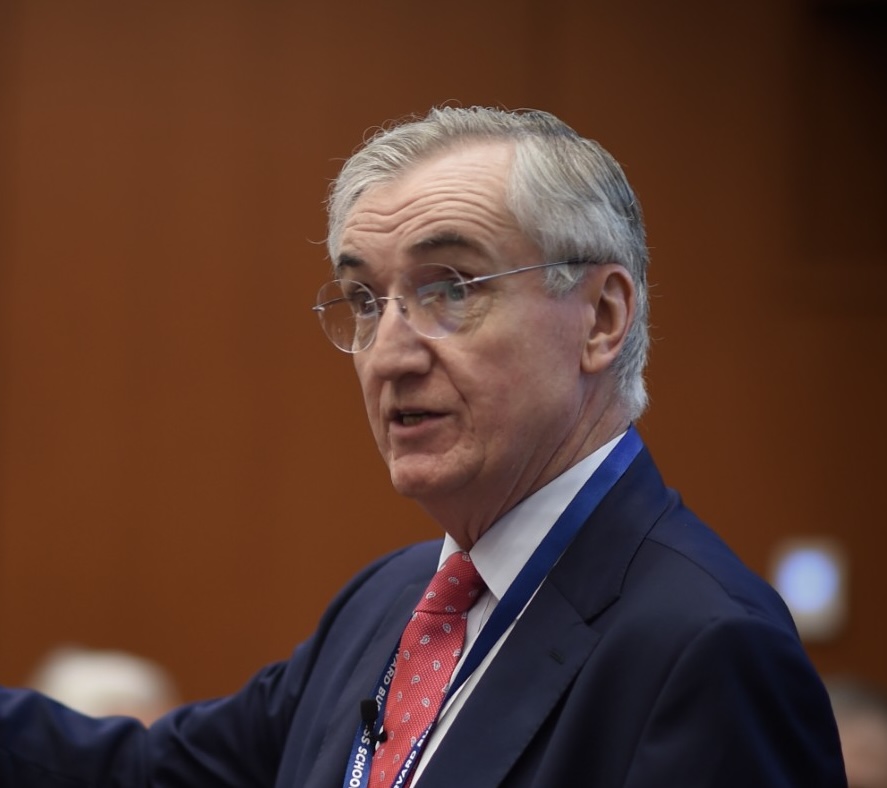
Professor of Management Practice, Harvard Business School
Joseph Fuller is Professor of Management Practice at the Harvard Business School and one of America's leading thinkers on the future of work. Before joining the faculty, he was a founder, first employee and long-time CEO of Monitor Group, the global strategy consulting firm, now Monitor-Deloitte.
Joe’s research focuses on two major topics, the changing nature of work and the evolution of the C-Suite. He founded and co-leads the Managing the Future of Work Project at Harvard Business School that researches issues of direct relevance to decision makers in business and government, including the impact of generative AI on the workforce. He co-hosts The Managing the Future of Work podcast that has been downloaded 2.5 million times. He also founded and co-leads Harvard’s Project on the Workforce, a collaboration between the Harvard schools of business, government and education. It studies issues related to lower skilled workers, including career pathways and the causes of income polarization and occupational segregation.
Joe is a widely published author. His work has appeared in periodicals including the Harvard Business Review, Wall Street Journal, Financial Times, Washington Post and the New York Times, The Atlantic, The Hill, Politico and Axios. He has appeared on the CBS Evening News, the NBC Evening News, France 24’s Evening Report, and PBS’s Marketplace and CNBC on multiple occasions. His work has been covered extensively in the Wall Street Journal, the New York Times, The Economist, Yahoo! Business and Fox Business.
Joe is a magna cum l… Read More