The Brands That Grow Best Understand the Hand-Offs That Matter

Marketing is often judged by what it creates at the top of the funnel.
Awareness.
Leads.
Interest.
Traffic.
Reach.
But business growth is rarely determined by the top of the funnel alone. It is shaped by what happens after that first moment of attention, in the hand-offs, the trust points, the relationships, and the operational realities where a brand promise either holds together or quietly falls apart.
That is especially true in franchising.
Franchise brands live and die by the brand hand-offs that matter, the moments where national awareness has to convert into local trust. A franchise brand can build national awareness, sharpen its value proposition, and invest heavily in strategic messaging. But if the local experience is disconnected from that message, or if the people responsible for delivering the brand do not understand how to turn trust into action, then growth becomes much harder to sustain.
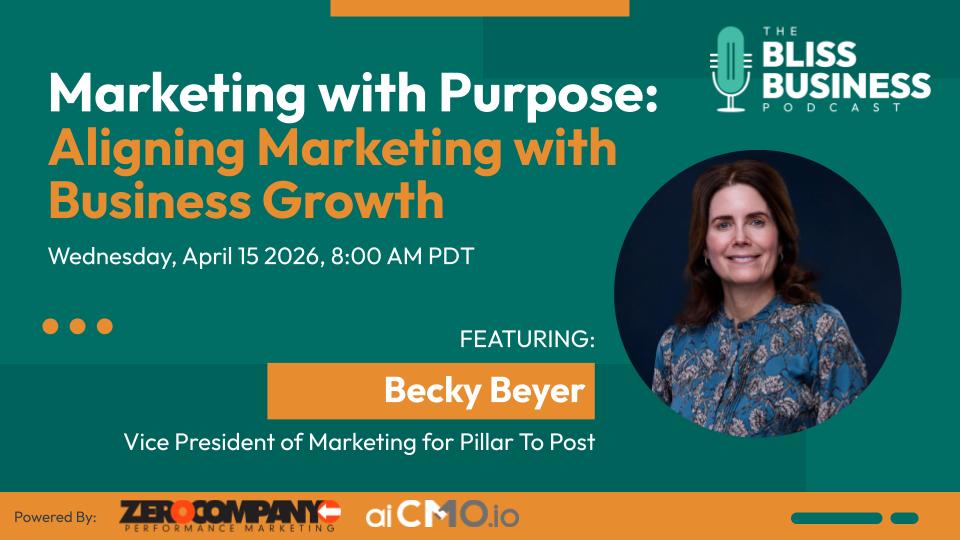
That theme came through clearly in a recent conversation with Becky Beyer, VP of Marketing of Pillar To Post franchise, on the Marketing with Purpose series of The Bliss Business Podcast. Becky brought a thoughtful franchise perspective to the conversation, shaped by years in real estate and franchise marketing. Her message was clear: marketing is not a nice-to-have. It is a strategic growth function. And when it is aligned properly to the business, it does far more than build awareness. It creates the trust, structure, and momentum that growth depends on.
Marketing Is Too Often Treated Like a Cost Until the Business Feels Its Absence
One of the strongest ideas in this conversation is Becky’s blunt reminder that many organizations still misunderstand marketing fundamentally.
When pressure hits, marketing is often one of the first places leaders look to cut. That instinct reveals something important: the business is still seeing marketing as an expense rather than an engine. If the function is viewed only as spend, it becomes vulnerable every time short-term fear enters the room.
But Becky is right. That is the wrong approach.
Because marketing is not simply decorating the business. It is driving awareness, positioning, trust, and ultimately demand. When companies cut it too sharply, they may not always feel the consequences immediately, which is part of what makes the mistake so dangerous. There is often a lag between the reduction and the decline. For a while, things may look fine. Then the pipeline weakens, visibility fades, and growth begins to stall in ways that are much harder to reverse quickly.
This is one of the reasons alignment matters so much. Marketing leaders have to keep helping the broader organization understand that consistent marketing is not just activity. It is infrastructure.
Franchising Magnifies the Importance of Alignment
Another valuable point Becky makes is that franchising adds a layer of complexity many non-franchise leaders underestimate.
At the brand level, marketing can do a tremendous amount. It can create national visibility, build a recognizable identity, develop programs, produce campaigns, and provide strategic tools. But once the customer experience moves into the local market, the outcome depends heavily on how franchisees show up, how they build relationships, and how well they execute the brand in the real world.
That is where alignment becomes everything.
Because the franchisor does not control every human interaction downstream. It can shape the system, but it cannot personally carry each relationship. That means growth depends not only on strong central marketing, but on whether the people closest to the customer understand how to build trust locally.
This is a crucial lesson for any multi-location brand. You cannot separate marketing from execution. If the local operator does not know how to translate the brand promise into a real experience, the system weakens no matter how strong the national campaign may be.
Sometimes the Most Important Growth Barrier Is Not Awareness. It Is Relationship Friction.
One of the most useful parts of Becky’s perspective is how directly she names a point of tension in the home inspection category: the relationship between inspectors and realtors.
That relationship is not peripheral to growth. It is central to it.
As Becky explains, a realtor spends significant time helping a client find the right home and guiding them toward a close. Then, near the end of that process, they effectively place part of that trust and potential income in the hands of the inspector. That is not a small moment. It is emotionally loaded and commercially significant. If the inspector mishandles it, the realtor absorbs the pain too.
This is where empathy becomes deeply strategic.
Rather than allowing inspectors to define the relationship from their own point of view, Becky pushes them to understand the realtor’s experience first. That shift matters. It moves the conversation from “Why do they not trust me?” to “What would make them feel safe trusting me?” Once that question changes, the marketing and training strategy can change with it.
This is a powerful example of what business growth often requires: not louder messaging, but a better understanding of what the other party is carrying into the interaction.
Empathy Makes Growth More Practical, Not Less
A lot of business language still treats empathy as if it belongs in the category of soft values rather than growth strategy. Becky’s examples show the opposite.
Her “try, trust, believe” framework is especially strong because it operationalizes empathy in a way franchisees can use. A realtor may not be ready to hand over meaningful business to an inspector they barely know. That does not mean the opportunity is lost. It means the trust journey needs to be built step by step.
First, lower the barrier and allow them to try the service.
Then create consistency so trust can form.
Then deepen the relationship until belief is established.
This is not just a clever sequence. It is a psychologically intelligent one.
It recognizes that people do not move from unfamiliarity to loyalty in one leap. They need evidence. They need experience. They need reasons to feel comfortable. Becky’s approach gives franchisees a usable way to create that movement deliberately rather than hoping it happens on its own.
That is exactly what strong marketing alignment should look like. It takes a human truth and turns it into a repeatable growth system.
The Biggest Misalignment Often Comes from Ego
Another important insight in the episode is Becky’s point that experienced operators can sometimes become resistant to doing the very things that help them grow.
That resistance often sounds like confidence.
But sometimes it is just ego.
A seasoned inspector may feel they have earned the right not to give away services, not to prove themselves, or not to ask for referrals. From their internal perspective, that makes sense. They know their experience. They know their quality. They know what they bring. But the market does not automatically respond to internal certainty.
The customer only knows what they have seen.
The realtor only knows what they have experienced.
The relationship is still new from their point of view.
This is where Becky’s leadership is especially grounded. She asks franchisees to set aside their own perspective long enough to enter the customer’s. You may be established to yourself, but you are brand new to them. That distinction can completely change how someone approaches sales, relationship-building, and follow-up.
In many businesses, the path to growth is not blocked by lack of skill.
It is blocked by reluctance to meet the customer where they actually are.
Data Can Expose the Gap Between Assumption and Reality
Becky also highlights an issue many leaders and operators run into: they assume success is more referral-driven or more self-sustaining than it actually is.
Inspectors may believe realtors will naturally refer them because they do good work.
But when the data is examined, the referral behavior does not always match that assumption.
That is an important moment.
Because this is where intuition needs to be checked by reality. Good performance does not guarantee word-of-mouth. Strong service does not eliminate the need to ask. And confidence in the value you provide does not replace the need to create a clear next step.
This is a great example of why metrics matter in service businesses. They do not just tell you what is happening. They help reveal where confidence has turned into complacency. They help identify where a relationship system needs to be strengthened with more intentional follow-up, clearer calls to action, and more consistent business development behavior.
Data, in this case, is not reducing the human side of the work.
It is helping people see where the human side is being neglected.
Strong Systems Help Franchisees Think Like Better Business Owners
One of the most compelling themes in Becky’s conversation is that franchise marketing is not only about giving franchisees campaigns. It is about helping them become more effective businesspeople.
That distinction matters.
Many operators are excellent in their craft. They know their service. They know their category. They know how to deliver the technical work well. But that does not automatically mean they know how to build a sales and marketing engine with the same discipline. That skill set often has to be taught.
Becky’s approach reflects this clearly. She is not just handing out tactical suggestions. She is creating planning systems, accountability tools, tracking mechanisms, and structured support that help franchisees stop treating marketing as an occasional reaction and start treating it as a core business discipline.
This is where franchisors can add enormous value.
A great franchise system should not only provide a recognizable name. It should help operators build the habits, rhythms, and strategic muscle required to grow sustainably in their local market. Becky’s work points to exactly that kind of support.
Quarterly Visibility Matters Because Waiting a Year Is Too Late
Another practical strength in Becky’s thinking is her insistence on regular measurement and adjustment.
She is absolutely right that it is not enough for an operator to try a set of tactics for a year and then decide whether any of it worked. That is too slow, too passive, and too costly. If marketing is going to align to business growth, it needs to be observed, evaluated, and adjusted consistently.
Quarterly review creates that rhythm.
It allows franchisees and support teams to ask better questions:
What is actually driving results?
What is not working yet?
Where should effort shift?
What is producing momentum that deserves more investment?
This does more than improve campaigns.
It improves decision-making.
It helps operators stop relying on vague impressions and start responding to signals early enough to change outcomes.
That kind of cadence is not just operational discipline.
It is a growth advantage.
Developing Talent Means Expanding Perspective
When Becky shifted to talking about internal teams, another key principle emerged: strong people grow when they are challenged and cross-trained, not when they are kept in the same narrow lane forever.
That is a very healthy view of leadership.
By moving people across teams and functions, Becky is doing more than preventing boredom. She is helping them build a more holistic understanding of the business. She is showing them how the pieces connect. And she is reinforcing something highly important in marketing leadership: no one should become so attached to a narrow definition of their role that they stop learning how the whole system works.
This matters for retention, performance, and succession.
It helps people feel more engaged because they are growing.
It helps the organization because it becomes less siloed.
And it helps the culture because people start to understand one another’s work from the inside instead of making assumptions from a distance.
That is how stronger teams are built.
Not just through specialization, but through shared context.
Entrepreneurs Often Need Help Seeing Their Own Bigger Story
One of the most moving moments in the conversation came when Becky shared the story of a real estate business owner who only later explained why her support had mattered so much.
He was preparing to retire.
What he needed was not just marketing activity.
He needed help seeing his business differently.
That is such a powerful reminder of what marketing leadership can be at its best.
Sometimes the value a CMO or marketing strategist brings is not merely tactical execution. It is perspective. It is the ability to see a larger pattern, possibility, or positioning that the owner cannot see because they are buried in the day-to-day. It is the ability to help them remember what is possible, what they are good at, and how to turn that into growth.
In that sense, marketing can become a form of business restoration.
It helps bring energy back into places where the operator has started to lose sight of their own leverage.
That kind of impact is hard to measure in a dashboard.
But it is often where the most meaningful transformation begins.
Key Takeaways
Marketing is a growth engine, not a discretionary expense. Cutting it impulsively often weakens the business later, even if the pain is not immediate.
Franchise growth depends on both brand-level marketing and local trust-building. National awareness alone cannot replace strong execution in the field.
Empathy helps uncover the real friction in key business relationships. Understanding how realtors experience the transaction changes how inspectors should market themselves.
Trust-building can be structured. “Try, trust, believe” is a strong example of translating empathy into a practical growth framework.
Experience does not eliminate the need to earn trust. Operators have to let go of ego and meet each new customer as if the relationship is new, because it is.
Data can expose where assumption has replaced strategy. Strong performance still needs intentional follow-up, referral systems, and measurable business development.
Better planning makes better franchisees. Sales and marketing systems should help operators think more strategically about how their business grows.
Final Thoughts
What this conversation with Becky Beyer, VP of Marketing of Pillar To Post franchise, makes clear is that aligning marketing with business growth is not simply about producing better campaigns.
It is about strengthening the relationships, systems, and behaviors that allow a business to keep growing after awareness is created.
That means helping franchisees think like business owners, not just service providers.
It means teaching them how trust is built locally.
It means using data to challenge comfortable assumptions.
And it means recognizing that the most important hand-offs in the customer journey are often the ones that determine whether a brand promise becomes a real experience.
That is where growth gets won.
Not just in the message, but in the alignment behind it.
Where to Go Next
Hear the full conversation: Marketing With Purpose Kit: Aligning Marketing with Business Growth. Watch it: Becky Beyer on the Try Trust Believe framework. Meet the guest: Becky Beyer.

Guest Development | Producer | Blog Contributor
Martha is a connector who brings over two decades of experience in engineering, sustainability, education, and public relations. She is part of the integrated go-to-market team at Zero Company and serves as Guest Development Lead for The Bliss Business Podcast, where she connects with purpose-driven leaders to shape meaningful conversations. Martha also produces the Marketing With Purpose Kit segments with CMO guests.
Her career includes founding nonprofits, and speaking at global forums in Malaysia, Dubai, and Paris. A passionate community builder, Martha also mentors women entrepreneurs and supports environmental initiatives across Mexico and the U.S. Her work reflects a deep commitment to impact, inclusion, and authentic leadership.

Empathy Is an Operating System