Stewardship Is the Heart of True Hospitality

Hospitality is often measured through occupancy, revenue, reviews, and repeat bookings. Those metrics matter, but they do not fully capture what is really happening when someone entrusts a company with a home, a vacation, or a family memory.
In hospitality, the deeper currency is trust.
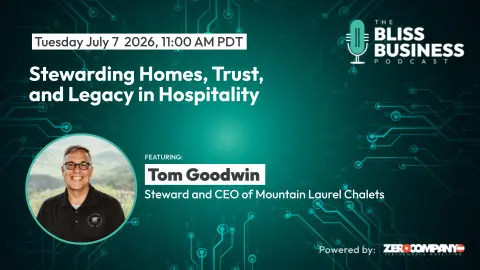
On The Bliss Business Podcast, we explored trust in vacation rentals with Tom Goodwin, Steward and CEO of Mountain Laurel Chalets, the original vacation rental company in Gatlinburg, Tennessee. Founded in 1972, Mountain Laurel Chalets has been family-owned for more than 50 years and has built its reputation around something increasingly rare in the vacation rental industry: stewardship.
Tom’s perspective challenges the idea that hospitality is simply about managing properties. For him, Mountain Laurel Chalets does not manage portfolios. It stewards homes.
Homes Are Not Inventory
The vacation rental industry has changed dramatically since Mountain Laurel Chalets began.
In the early days, families booked trips by phone or mail. There were no online platforms, no instant booking, no 360-degree tours, no review systems. The company’s original marketing materials included pencil sketches of homes, basic descriptions, and trust built through real conversations.
Today, anyone can list a property online in minutes. Technology has made access easier, but it has also made hospitality feel more transactional.
That is why Tom makes a distinction between managing homes and managing portfolios.
A portfolio is an asset class.
A home is personal.
For homeowners, a vacation property may be an investment, but it can also be a family retreat, a legacy asset, or a place filled with history. For guests, the home becomes the setting for birthdays, anniversaries, reunions, quiet recoveries, and once-in-a-lifetime memories.
When a company sees homes only as units of inventory, it risks missing the human story attached to them.
Hospitality Is a Calling
Tom describes hospitality as a calling, not simply a business model.
For Mountain Laurel Chalets, that calling is rooted in a clear purpose: to change lives. Tom wants every guest, homeowner, and employee to leave better than they came.
That is what stewardship means.
To steward something is to receive what is not yours and return it better than you found it. That applies to a homeowner’s property, a guest’s vacation, and an employee’s experience inside the company.
That mindset changes everything:
-
how the phone is answered
-
how a home is cleaned
-
how a guest is welcomed
-
how an issue is resolved
-
how a review is handled
-
how employees are treated
-
how the community is protected
When the purpose is life change, every operational detail becomes part of the hospitality experience.
You Cannot Add Empathy After the Fact
Tom made one of the most important points of the conversation: it is easier to build systems around empathy than to inject empathy into systems after they are already built.
Many companies begin with efficiency. They perfect the booking process, optimize pricing, automate communication, reduce costs, and standardize operations. Then, after everything becomes cold, they try to add empathy back in.
That rarely works.
Mountain Laurel Chalets was built differently. Its founders began with care. The systems came later to support that care.
That order matters.
Empathy cannot be a decorative layer on top of a transactional model. It has to be part of the foundation. Once care is foundational, technology and systems can strengthen it instead of replacing it.
Repeat Guests Are Built Through Relationship
Mountain Laurel Chalets has a 59 percent repeat booking rate, which means more than half of its bookings come from guests who have stayed before.
That does not happen by accident.
The company keeps history. They know when guests have visited, what they have celebrated, what they may be returning for, and what details matter. They listen before the stay begins so they can personalize the experience.
One example is how they welcome dogs.
About a quarter of Mountain Laurel Chalet properties are pet friendly. When guests bring a dog, the dog is registered too. The team learns the dog’s name, breed, treat preferences, and even prepares the right water bowl and welcome card.
That may sound small, but for a pet owner, it communicates something powerful: we see your whole family.
Hospitality is often remembered through details like that.
Longevity Creates Trust
Mountain Laurel Chalets’ leadership team has extraordinary tenure. Some team members have been with the company for 20, 21, and even 37 years.
That kind of continuity matters in hospitality because guests and homeowners build relationships with people, not just brands.
Guests know employee names. They send wedding invitations and funeral announcements. They write emails filled with personal details. Some former guests even become employees because the relationship with the company becomes meaningful enough to continue in a different form.
Longevity strengthens memory. It helps the organization remember people, stories, homes, preferences, and moments that would disappear in a more transactional model.
When employees stay, trust compounds.
Listening Creates Moments of Meaning
Tom emphasized that empathy requires listening. The company’s goal is not simply to get a booking as quickly as possible. It is to understand what the guest wants to experience.
Who is coming?
What are they celebrating?
What do they need?
What would make this trip meaningful?
That listening creates opportunities for surprise and delight.
If a guest is celebrating a 100th birthday, the company can prepare something special. If someone is coming for a final family trip, the team can respond with care. If a pet is joining the vacation, the welcome can extend to the dog.
The most powerful moments are often not scripted. They are discovered through attention.
A Small Gesture Can Last a Lifetime
One of the most moving stories in the episode involved a guest named Tammy, who came to Gatlinburg after being diagnosed with an aggressive form of ALS. She wanted to see the mountains and a bear one more time.
Tom visited the home with a small bear mascot named Ralph, originally thinking it might comfort a child in the family. Instead, the bear went to Tammy. She held it throughout the rest of her trip and continued holding it during the final weeks of her life.
Mountain Laurel Chalets later sold bears in Tammy’s honor and raised funds for an ALS foundation that supports patients with equipment and accommodations.
That story captures the essence of hospitality as stewardship.
The gesture was simple.
The impact was lasting.
You cannot always predict which moment will matter most. But if the organization moves with care, it will be ready when the moment appears.
Hire for Heart, Train for Skill
An audience member asked how to screen applicants for heart when the hiring market is difficult.
Tom’s answer was practical. He asks questions that reveal character, curiosity, spontaneity, and self-awareness, not only technical capability. Skills can often be trained. Heart is harder to manufacture.
That is especially important in a hospitality business where employees are constantly representing the company’s care standard.
Mountain Laurel Chalets also intentionally keeps the business at a scale that matches its ability to maintain quality. Tom shared that he could add many more cabins, but the company would not be able to sustain the same experience without the right people.
That is a leadership discipline many companies ignore.
Growth is not good if it breaks the promise.
Technology Should Amplify Care
Modern hospitality depends on technology, but Tom is clear that technology should be a tool, not the heart of the experience.
Mountain Laurel Chalets uses automation, personalized communication, and a carefully selected technology stack to create efficiency. The purpose is to free the team to spend more time on the human experience.
Tom is also exploring AI to help capture deep property knowledge. Long-tenured employees know the intricate details of each home, but that knowledge needs to be preserved and made accessible. By recording details about homes and using AI to organize that information, the company can equip hospitality ambassadors to serve guests with more accuracy and care.
This is the right use of technology.
Not to replace hospitality.
To make hospitality more informed, responsive, and personal.
Scale Can Put Legacy at Risk
The vacation rental industry is being reshaped by private equity, portfolio operators, and technology-first platforms. That shift brings efficiency, capital, and scale, but it can also put something important at risk.
Tom believes the risk is losing legacy, story, and the human experience.
When hospitality becomes only about maximizing occupancy and short-term returns, it can lose sight of the eight-year-old running through the mountains, the family returning for a fifth generation, the homeowner preserving a retreat, or the guest who needs one meaningful trip before life changes forever.
That is what stewardship protects.
It protects the long game.
It protects memory.
It protects meaning.
Stewardship Is the Opposite of Consumption
Tom contrasted stewardship with consumption.
Some operators consume homes. They extract as much revenue as possible in the shortest amount of time. Some consume guest dollars. Some consume employees, trying to squeeze more and more out of them until they burn out.
Mountain Laurel Chalets aims to do the opposite.
It stewards homes.
It stewards vacations.
It stewards employees.
It stewards community.
It stewards the natural environment of Gatlinburg and the Smoky Mountains.
That distinction is powerful.
A consumption mindset asks, “How much can we take?”
A stewardship mindset asks, “How can we leave this better?”
That is the difference between extraction and care.
Love Creates Win-Win Outcomes
When asked what role love should play in business, Tom pointed to consistency across all audiences: guests, homeowners, and employees.
Love cannot be expressed to one group at the expense of another. True love in business creates value for all stakeholders. It is care without compromise, empathy without favoritism, and service that does not cheat one group so another can gain.
That is what makes stewardship so powerful.
It does not rely on scarcity. It operates from abundance.
When businesses steward instead of consume, profit can still follow. But it follows as the result of trust, care, consistency, and long-term value creation.
Key Takeaways
-
Hospitality is not only about occupancy, revenue, and reviews. It is about trust.
-
A home is not just an asset. It can be an investment, legacy, family retreat, and memory container.
-
Stewardship means returning what you receive better than you found it.
-
Empathy works best when it is foundational, not added after systems are already built.
-
Repeat business is built through listening, personalization, and relationship memory.
-
Employee longevity strengthens guest trust because relationships compound over time.
-
Small gestures can have life-changing meaning when they meet the right moment.
-
Hiring for heart matters because skills can be trained, but care must be present.
-
Technology should amplify care, not replace the human experience.
-
Stewardship is the opposite of consumption. It asks how to leave people, homes, and communities better.
Final Thoughts
Tom Goodwin’s approach to hospitality is a reminder that the best businesses are not built only on efficiency. They are built on trust.
Mountain Laurel Chalets has endured for more than 50 years because it treats homes as more than inventory, guests as more than bookings, and employees as more than labor.
That is what stewardship does.
It preserves what matters while preparing the business for what comes next. It honors the past, serves the present, and protects the future.
In an industry increasingly shaped by scale, automation, and short-term returns, stewardship may be the most human competitive advantage of all.
Where to Go Next
Hear the full conversation on the Stewarding Homes, Trust, and Legacy in Hospitality episode, watch the video version, or learn more about Tom Goodwin. Trust in vacation rentals isn't automated. It's built through stewardship, one relationship at a time.

Executive Producer | Host | Blog Contributor
Tullio Siragusa is a strategic advisor, dynamic speaker, author, and EQ coach with 36 years of experience as a technology disruptor rooted in Design Thinking. Since 2018, he has been creating, producing and hosting live podcasts, interviewing over 1,000 C-suite executives across a wide range of industries. His work behind the mic reflects his larger mission: using conversation as a catalyst for human-centric innovation.
Tullio’s commitment to purpose-driven leadership and ethical transformation is reflected in his advisory roles at the University of California, Riverside’s Design Thinking Executive Program, and the University of San Francisco School of Management’s Digital Marketing Program. As a Board Advisor at AI2030.org, he helps guide the responsible advancement of AI toward ethical and sustainable outcomes. A founding member of RadicalPurpose.org, Tullio believes empathy isn’t just a trait, it’s a non-negotiable foundation for leadership.

Hospitality Begins With Making People Feel Seen