Scaling Sustainability Through Local Ownership
Sustainability is often discussed as an environmental commitment, but in business it is also a design challenge. Responsible practices have to work operationally, economically, and at scale. They cannot remain side initiatives or marketing promises that disappear when growth becomes difficult.
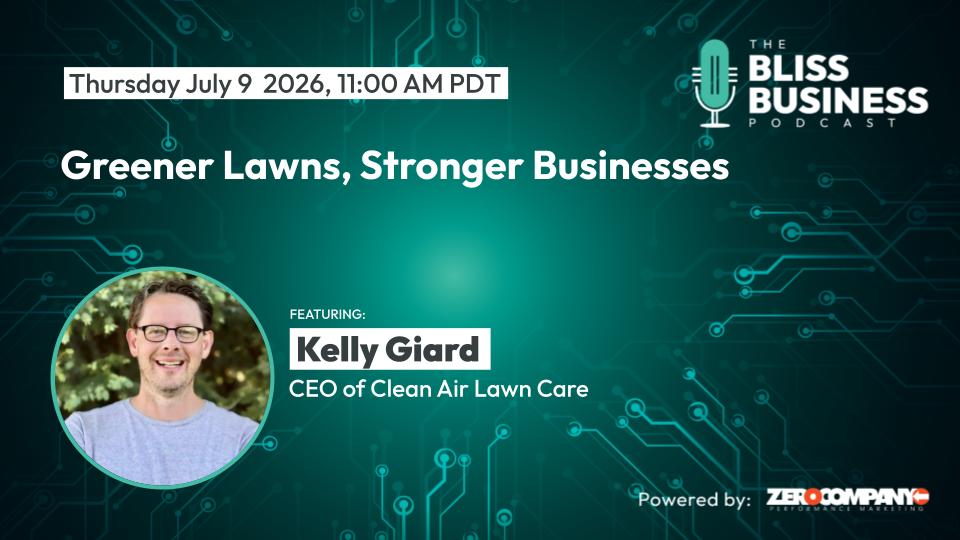
On The Bliss Business Podcast, we sat down with Kelly Giard, Founder and CEO of Clean Air Lawn Care, to explore sustainable franchise ownership and what it takes to build sustainability into the foundation of a business model. Kelly began developing Clean Air Lawn Care from his garage in Fort Collins, Colorado, after a career as a stockbroker and financial services franchise owner. His goal was to offer a cleaner alternative to conventional lawn services through electric mowing equipment, solar charging, organic fertilization, and natural weed control solutions.
What started as a bold local concept has grown into a national franchise network built around environmental responsibility, local entrepreneurship, and services designed to be safer for children, pets, families, neighborhoods, and the planet.
Sustainability Has To Be Built Into the Model
Kelly’s inspiration came from learning that the EPA estimated 10 to 12 percent of the nation’s air pollution was coming from small engines, much of it tied to lawn care equipment such as mowers, trimmers, and blowers.
That insight turned into a practical question: could lawn care be done differently?
For Clean Air Lawn Care, sustainability is not an add-on. It is built into the equipment, the products, the operations, and the customer experience.
That distinction matters.
A company can talk about sustainability and still run the same underlying model. Clean Air Lawn Care redesigned the model itself.
A Different Kind of Lawn Care Experience
Kelly described Clean Air Lawn Care as more of an experience than a commodity service.
Traditional lawn care often comes with noise, fumes, gas-powered equipment, and chemical smells. Clean Air Lawn Care offers a different sensory experience: quieter equipment, fresh-cut grass, earthy organic fertilizer, and natural mosquito control products with scents like citronella and garlic.
The difference is not only environmental. It is emotional.
Customers can sit in the backyard while the team works out front without feeling interrupted. Children and pets do not have to be rushed inside. The service feels more like a personal gardener experience than a disruptive industrial process.
That matters because sustainability is easier to adopt when customers can feel the improvement in their daily lives.
Purpose Made the Risk Worth Taking
Kelly came from the financial services world, where there were many ways to make money. But he wanted to build something with a deeper mission.
He admired companies like Patagonia and wanted to create a business that could make money while also solving a real environmental problem.
That sense of purpose helped him push through the early difficulty of building a category that was not yet mainstream.
When Clean Air Lawn Care started, the equipment was not what it is today. Early electric blowers were weak. Batteries were not easily swappable. The technology was inferior in many ways to gas-powered alternatives.
But the mission made the inconvenience worth solving.
That is often how meaningful innovation begins. Not with perfect tools, but with a problem worth staying committed to.
Early Customers Were Part of the Movement
Because the early equipment was still developing, Clean Air Lawn Care had to earn trust with customers who were willing to be patient.
Those customers were not simply buying a lawn service. They were participating in a better way of doing lawn care. They understood the environmental mission and were willing to give the company room to improve.
That early adopter mindset was essential.
When customers believe in the mission, they become more than buyers. They become partners in the evolution of the business.
Innovation Happens One Constraint at a Time
Clean Air Lawn Care’s model required constant innovation.
The company incorporated electric equipment, solar charging systems, organic fertilizer, and natural treatments. Kelly’s father, a retired electrical engineer, helped design early solar systems for the trucks, turning them into mobile solar generators that could charge equipment during the day.
The solar setup became both an operational advantage and a marketing signal. It extended the workday, improved consistency, and visibly reinforced the company’s environmental commitment.
That is what good innovation does. It solves a real operational problem while strengthening the brand promise.
Organic Lawn Care Can Change the Soil
One of the more interesting points Kelly shared was the carbon impact of organic lawn care.
Through research with a scientist at Colorado State University, Clean Air Lawn Care found that switching a lawn from chemical-based treatment to organic treatment can increase carbon sequestration because of the microbial activity in the soil.
That insight expands the meaning of sustainable lawn care.
It is not just about reducing emissions from equipment. It is also about improving soil health, reducing chemical exposure, and helping ordinary residential landscapes become part of a healthier environmental system.
The lawn becomes more than grass. It becomes a living system.
Franchising Scales the Mission Locally
Kelly chose franchising because the model aligns with local ownership.
Clean Air Lawn Care franchise owners usually live in or near the communities they serve. They sponsor local soccer complexes, connect with pollinator groups, attend local events, and build trust face to face with homeowners.
That local connection matters because lawn care happens at people’s homes. Customers are allowing someone onto their property, around their children, pets, and private spaces. Trust is essential.
A remote, impersonal model would miss that layer of relationship.
Franchising allows the brand to scale while keeping ownership close to the community.
Local Ownership Keeps the Money Local
Kelly also pointed out that in Clean Air Lawn Care’s franchise model, most of the revenue stays local. He noted that 94 cents on the dollar remains in the local market.
That is part of the company’s broader purpose.
Sustainability is not only environmental. It is also economic. Local ownership helps create local jobs, local relationships, and local accountability.
When a business is rooted in a community, it is more likely to care about the long-term health of that community.
The Right Owners Need More Than Financial Motivation
Clean Air Lawn Care looks for franchise owners who are motivated by more than money.
Kelly said strong franchise owners need “the fire outside of the money.” They may be drawn to the model because of a personal health story, a pet, a family experience, an environmental class, or a long-standing desire to do work that has impact.
Many owners do not come from lawn care backgrounds. They are attracted by the mission, the recurring revenue, the lifestyle control, and the ability to build something meaningful in their own community.
That is important because purpose-driven franchises require purpose-driven operators.
The system can train the work. It cannot manufacture the why.
Community Among Owners Strengthens the System
Clean Air Lawn Care also works to build community among franchise owners across the country.
They use digital tools like Teams, host a national conference, and encourage open communication. Kelly described an owner community where people can speak freely, share ideas, challenge leadership, and learn from one another.
That matters because innovation does not only come from headquarters.
Many improvements come from franchise owners who are close to the field, testing ideas, solving problems, and sharing what works. When the system allows those ideas to move quickly, the whole network gets stronger.
Empowering Technicians Into Ownership
One of the most powerful examples of systemized opportunity is Clean Air Lawn Care’s technician ownership pathway.
The company created an 18-month program where a technician can work with a local franchise owner toward specific goals. If those goals are met, the technician can be awarded a territory without paying the franchise fee, which Kelly said is currently $40,000.
That is a meaningful way to build upward mobility.
Many technicians may not have the capital to start a business, but they have the work ethic, knowledge, and commitment. This program creates a bridge from labor to ownership.
It also creates franchise owners who deeply understand the work because they have done it themselves.
Sustainability Has To Compete Economically
Purpose matters, but the business still has to work.
Kelly explained that in the early years, Clean Air Lawn Care could cost up to 100 percent more than traditional competitors. Today, because of improvements in technology and operations, the premium is closer to 10 to 20 percent.
That is an important evolution.
The more sustainable options become operationally competitive, the easier it is for customers to choose them. Purpose can open the door, but the economics have to support adoption.
Clean Air Lawn Care’s progress shows how innovation can move sustainability from niche to mainstream.
Love Shows Up as a Leadership Choice
When asked what role love should play in business, Kelly shared something written on his whiteboard: choose love, not fear or anger, when starting the day or approaching a problem.
That is a practical leadership discipline.
Business brings problems to the desk every day. Leaders can respond with fear, anger, ego, or control. Or they can pause and choose a better posture.
Kelly also emphasized humility as a superpower. Owners who make decisions without pride or ego tend to do better.
That combination of love and humility is powerful because it helps leaders listen, learn, adapt, and serve without becoming defensive.
Key Takeaways
-
Sustainability has to be built into the business model, not added as a marketing message.
-
Clean Air Lawn Care redesigned the lawn care experience through electric equipment, solar charging, organic fertilization, and natural treatments.
-
Early customers were willing to support the mission even when the equipment was still evolving.
-
Innovation improves adoption by making sustainable options more operationally and economically competitive.
-
Local franchise ownership builds trust because lawn care happens inside people’s communities and homes.
-
Purpose-driven franchise owners need motivation beyond money.
-
Franchise communities can accelerate innovation when owners openly share best practices.
-
Technician-to-owner pathways create upward mobility and strengthen the local system.
-
Sustainability becomes more scalable when the price gap narrows and the customer experience improves.
-
Love in leadership means choosing humility, care, and purpose over fear, anger, and ego.
Final Thoughts
Kelly Giard’s story is a reminder that sustainable business is not built through slogans. It is built through equipment choices, product design, pricing discipline, local ownership, soil health, training, technology, and culture.
Clean Air Lawn Care shows how a traditional industry can be reimagined when purpose becomes operational.
The future of sustainability will not depend only on better intentions. It will depend on better systems.
Where to Go Next
Listen to the full conversation: Greener Lawns, Stronger Businesses with Kelly Giard.
Watch the video: Greener Lawns, Stronger Businesses with Kelly Giard.
Meet more Bliss Business Podcast guests on our guest page.
Executive Producer | Host | Blog Contributor
Tullio Siragusa is a strategic advisor, dynamic speaker, author, and EQ coach with 36 years of experience as a technology disruptor rooted in Design Thinking. Since 2018, he has been creating, producing and hosting live podcasts, interviewing over 1,000 C-suite executives across a wide range of industries. His work behind the mic reflects his larger mission: using conversation as a catalyst for human-centric innovation.
Tullio’s commitment to purpose-driven leadership and ethical transformation is reflected in his advisory roles at the University of California, Riverside’s Design Thinking Executive Program, and the University of San Francisco School of Management’s Digital Marketing Program. As a Board Advisor at AI2030.org, he helps guide the responsible advancement of AI toward ethical and sustainable outcomes. A founding member of RadicalPurpose.org, Tullio believes empathy isn’t just a trait, it’s a non-negotiable foundation for leadership.

Culture Becomes Real When It Becomes a System